Four Mapels

Four Mapels

Wednesday, February 3, 2016

Dear Hillary Clinton Supporters,

I live in Iowa.  I was at the caucus.  My local precinct contained all of 56 people and we argued over who would win our one delegate for almost an hour before it finally fell to Bernie by one person.  Emotions ran high on both sides and the debate was fierce, but it was clear at some point that there would be no swaying the Hillary camp and there would be no swaying the Bernie camp.  It would come down to the three O’Malley supporters and the one undecided to make or break it for one candidate.  


I am as happy as the rest of Iowa that the caucus is over.  The spotlight was burning just a little too hot this year, but for a very good reason.  Democracy is in full swing.  Full disclosure, I was a precinct captain for Bernie Sanders.  I was asked early in the campaign to help corral the masses in his corner.  This was a huge leap of faith for me because I am, by nature, a complete introvert bordering on recluse.  It requires a huge amount of energy for me to walk up to people, introduce myself and engage them in conversation, especially political conversation.  On top of that, some of the houses that I walked up too had clearly written notices, “This House Protected by Smith and Wesson” so not only was I outside my comfort zone, but there was a chance that I could have been shot as well, so strong is my support of Bernie.  

I know that Bernie supporters lately have gotten something of a bad rap as being “over the top” a little overzealous, but let me give you a perspective for one such “over the top” supporter.  
Hillary is more than capable.  Of this I have no doubt.  She is vetted, she has survived being First Lady married to Bill, she has been a U.S. Senator, she was Secretary of State.  She has, time and again, proven her worth and would do a fantastic job of running the country in relatively the same way it has been run for the last eight years.

But there is the rub.  I know that Hillary knows how to play by the current rules.  She knows the ins and outs of campaign finance, the rules of engagement when it comes to dealing with Republicans.  She knows how to walk the Wall street walk and talk the lobbyist talk in order to get the financial support that comes in handy to someone running a campaign, but it is at that point that the average Bernie supporter starts to build up a head of steam and launch overboard.

We, the average people, have watched for the last eight years as deals have been made - some good, some bad, but all of them mostly excluding us entirely.  We have watched as the Affordable Care Act became mostly affordable to the large insurance companies that continue to demand high premiums while simultaneously demanding large deductibles.  We have watched while the upper 1% has continued to amass huge sums of money, while we scrape the change off the floors of our cars to give to the local homeless guy - a veteran missing both his legs that panhandles on the corner every day of the week.  Enough is enough.

So along comes an angry, Jewish, Democratic Socialist in the twilight of his career that says simply and straightforwardly, “The system is rigged and this is how”.  There is not one point that he makes that doesn’t ring true in our average person heart.  We are tired of working more than one job and still not being able to make ends meet, we are tired of funding wars that only lead to more terrorism, we are tired of not getting the healthcare we need, we are tired of watching corporations buy politicians and establish whatever loopholes are necessary to line their pockets nicely while simultaneously bleeding us dry.  We are tired of watching the environment get raped while we wonder why it is that people in Flint are being quietly poisoned with water that flows through their pipes.

In short, we are tired.

When something isn’t working you have three options:  You can do nothing and continue on being tired and frustrated, you can backtrack and become fearful and hate-filled (take heed, for beyond this point there be Republicans), or you can move forward and change the system. Bernie Sanders is option number three.  

There is power in progress.  There is power in seeking out solutions to problems and tackling them even when the odds are stacked against you.  There is mastery in reaching for the stars.  It is what starry-eyed people from the 1960s see when they think about what JFK said about going to the moon.

“ This is a breathtaking pace, and such a pace cannot help but create new ills as it dispels old, new ignorance, new problems, new dangers. Surely the opening vistas of space promise high costs and hardships, as well as high reward.
So it is not surprising that some would have us stay where we are a little longer to rest, to wait. But this city of Houston, this State of Texas, this country of the United States was not built by those who waited and rested and wished to look behind them. This country was conquered by those who moved forward…” JFK September 12th, 1962.

Forward. To a country that is not ruled by the billionaire class.  Forward to a country where a medical diagnosis doesn’t demand that you sell your house to pay for treatments. Forward to a time when a country doesn’t go to war unless they can pay to take care of the veterans that come home.  Forward to a country whose children can boast of the best education without the mountain of debt.  Forward.
Even Rome in the 1300s understood forward. They built a cathedral in Florence for which they had no idea how to design or build the dome.  For a hundred years it stood with the certainty that it would be built and finally in 1436, a man by the the name of Filippo Brunelleschi engineered and built the dome on what would become the most renowned cathedral in Florence, Italy. Now that is some serious faith.

There are any number of people that will say, “It isn’t possible!”  “It will NEVER, EVER happen!”.  Maybe that is true, but that very thought would have kept the U.S. on the ground in the 1960s, we would have never gone to the moon.  That thought would have torn down the sides of the cathedral decades before the engineer that would eventually build it would even be born.  
It is so easy to give up.  It is, after all, what they want us to do….stay poor, stay dumb, stay sick, stay anesthetized by the latest reality T.V. spectacle while they quietly take away our liberties, our healthcare, our young men to wars to defend their oil interests in the Middle East.  

I say rise up.  Enough is enough.  


So, Dear Hillary supporter, you have before you a populace that is very much awake and aware. Most of us are, for the first times in our lives, really politically involved and energized.  We are not upset with you and your choice of candidate, but we sincerely hope that you can come to understand, if not respect, the anger that many of us are feeling at being duped for so long by the “system” of which Hillary is still very much a part.  “Forward” sometimes requires a push….that is what Bernie (and his supporters) are doing.   Sometimes we are loud and obnoxious, sometimes we post too many Bernie related things to our Facebook pages, sometimes we feel it necessary to point out the differences between the two democratic candidates in such a way that we appear to be attacking Hillary (and there are differences), but it comes down simply to what Martin Luther King Jr so eloquently expressed: “Human progress is neither automatic nor inevitable... Every step toward the goal of justice requires sacrifice, suffering, and struggle; the tireless exertions and passionate concern of dedicated individuals.” and we are those dedicated individuals.

Friday, November 21, 2014

And Now For Something Completely Different

When I am not busy in the garden, or chasing kids around, or working as a veterinarian to stamp out disease and pestilence.....I am running. Technically, I have been running since I was about 18 months old (as have most humans), but I grew up in a track and cross country family and so the bug bit me early.  This time of year, the running becomes a little more challenging because of the cold and ice, but my beloved treadmill (aka "dreadmill") lives downstairs in my basement and works as an effective hamster wheel throughout the cold months.

Why do I run? Sometimes people ask.  Mostly they just shake their heads and think I am nuts, but at least in this family, I am in good company - my husband runs, my son runs, and now my daughters are taking it up as well.

Marathons are my current distance of choice, and because of that, there are many hours spent running in preparation.  What follows are some of the reasons for "why I run" that my conscious mind has endeavored to latch on to when the potentially more rational parts of my brain try to get me to take a nap on the couch instead.

1. "Just Do It."
    Somewhere out there is a marketing person that has retired and is living large because of that slogan, but honestly, those three words have hauled my sorry butt out of bed in the dark of the morning and have helped me to slog those last agonizing miles home more times than I like to admit. There are thousands of reasons why I shouldn't run or don't need to run, or can't run and my brain will attempt to find them all.  It is only when my brain over rides the nay-saying with "Just Do It" loud enough that I get up and get going.  I have never regretted this phrase because I always feel better after I have Just Done It.

2. The thrill of seeing wildlife
     I see wildlife every day - on the way to work, on the farm, etc.  But there is something sort of magical about running around a bend and suddenly finding a deer and her fawn standing there on the trail, or a raccoon or skunk waddling along.  The occasional turtle and snake to leap over, or the ermine that dodges into the grass.  The herons that take flight and sore across the lake or the eagles that perch and stare down at me while I run by.  Running seems to catch many wild animals off guard because it allows a person to get into their territory quickly before they have the time to skitter away. I have seen more wild animals while running then ever while walking.

3. Seeing people (and pets) I know
    As a veterinarian, I see a lot of the clients and patients that I know while out running.  It is fun to be running toward a dog I know and say, "Hey Spike!" and have the dog stop in it's tracks and try to figure out how this person knows their name.  Same goes for the owners because, out of context I am just another runner passing by on the sidewalk, but when they realize who I am there are usually shouts of "hello!" and wagging tails.  Seeing other runners, whether I know them or not, is also fun.  I feel as though I share some amount of camaraderie with them just because we are both out pounding the same pavement and there are usually waves and hellos whether we know each other or not.

4. My kids
    Yes, I run for my kids.  I run because I want them to see an example of maintaining one's health and vitality as long as possible.  I want to be able to demonstrate for them that a person doesn't have to always win at something to enjoy doing it.  And, who am I kidding, I like to be able to beat them in a race or at least say I have run further than they have.  This is, of course, getting harder and harder, but it is a challenge none-the-less.


5. The distilling power of pain and discomfort.

I won't lie, sometimes running hurts....a lot.  I have had one broken ankle and one severely dislocated ankle in my lifetime and everyday (whether I run or not) one or both ankles will ache at times. Running long distances can be brutal on a person's body, but there is something in that masochistic behavior that is not unlike tempering steel into a honed blade.  I feel like I get fired up, pounded flat, and then folded again and again until I come out hardened and sharp.  I run until the pain is sometimes unbearable.... go a few miles more....and then I know I can stand anything.

6. How my legs look in short skirts
    Vanity is a perfectly legitimate reason for lacing up and heading out as long as it isn't the only reason. Sometimes, when other encouragements are failing, the thought of a new dress or shorts is enough to move me in the right direction.

7. Resting heart rate of 50 beats per minute.
    Studies have found that, in general, a person gets roughly 1 billion heart beats in their life.  So, in other words, the slower your heart beats on average, the longer you may live.  This makes fairly good sense.  When your heart is good at pumping blood and oxygen, when your muscles and organs are resourceful at utilizing energy with less waste, it makes the whole process easier and more efficient.

8. Eating and drinking
    My Hobbit lifestyle of loving food and drink is best served by running.  There is really nothing that I restrict when I am in the middle of training - whatever my body wants to eat or drink, it gets (within reason of course)  That is not a bad way to live, if you ask me.

9. The mental conversations - all the inner voices show themselves
    When I run I will often step outside of my own head and just listen to the voices in my brain battle it out.  For example,
Voice #1  "Why are you doing 12 miles today? You just did 8 yesterday!"
Voice #2, "Why not do 12 miles? You have to run twice that in a few weeks, you had better be able to pull it off."
Voice #1 "Yeah, but you don't want to get injured! Take it easy"
Voice #2 "Whatever! Clear out, we need to go for a run."
And this will continue on for 12 miles if I let it.
   Some might say that this sounds a little schizophrenic, but if you have ever tried meditating, this is what you are instructed to do - let the voices rattle on and recognize them for what they are, your ego attempting to maintain control - and then let them go....no more voices, just quiet clear space in which to run.   Running is my meditation.

10. Finishing
      There is really no better feeling than crossing a finish line knowing that you have put forth your best effort on that particular day.  The memory of crossing that line drives me along when I wonder if the tempo runs or hill workouts are really worth it.

11. That little thrill of butterflies just before the gun goes off
      I used to hate this feeling, but I have come to recognize that it is my body's way of saying "I am ready" by giving it that little jolt of epinephrine that can help to override the voice that likes to say, "What are you doing?"

12. Learning to respect my physical boundaries
      This has been a tough lesson to learn and one that has become more common in the last several years.  There is only so much that I, physically, can do.  There are certain records that I will never break, and likely personal records that I will never break again, but each day is new and each race is a new race...."I have never run this half marathon as a 41 year old....only as a 40 year old."  Rather than being depressed about getting older, I have to meet the challenges and accept them from my current point of reference.  Pining for lost youth and lost speed it pointless, and self defeating.  By focusing on doing the best that I can on this day, at this age, at this fitness level - let's just say that this year alone I have managed to pull off three personal records in racing as well as countless others on a daily basis in training.

13. Aging gracefully
      Sometimes it is hard to run knowing that my fastest days are likely behind me.  I see my husband struggling with this as his son has caught and passed him in a 5k earlier this year.  But then I have witnessed people almost twice my age out there tackling a course one hill at a time and I am inspired by them. They have tackled many of the same worries - loss of speed, ability to recover from injury-that I ponder, and they are still out there doing it and it helps to keep them stronger - mentally and physically.  If they can do it, I can too.

14. Weird tan lines
      You have to have a sense of humor when running - you will have weird tan lines.  Sock lines, short lines, sport bra lines, running number lines.  These can make for interesting conversations.  I like to think of them as my proof of absorbing a little Vitamin D and I carry these lines into the winter as a reminder of what spring and summer will bring again.

15. Bragging rights
      You do the work, you earn the right to brag about it if you want to.  You don't do the work, you don't get to brag.  I have decided that the times I feel the need to brag the most is when I am feeling low and overwhelmed by the task that I have carved out for myself.  I know some people really hate to hear about all the miles and runs that people put in, but once in a while just nod and smile and say "Nice job"...that's really all the gratification we are looking for and, for me, may be just the boost I need to tackle the next workout with enough self satisfaction that I won't say a thing.


16. Big crowds of people as crazy (or crazier) than I am

      I love big running races.  Boston takes the cake in my opinion - never have I seen so many people turned out for a running event in all my life - 26.2 miles of cheering crowds.  But even the smaller races with a smaller crowd of people are fun.  The group of people that toe up to any starting line are all in it for a reason that may be similar to yours, or they may be on a totally different running trajectory, but I have yet to meet a runner that laughs at your reasons for running.  More likely they will encourage you - no matter what the reason, cause, goal, pace, or level of expertise.  Runners are simply like that.  I have been in any number of races where someone will fall and, without fail, the runners around them stop, help them up, brush them off, make sure they are okay, and then give them an encouraging word before continuing on. That's the running crowd and I love it.

17. People telling me I am crazy
      I know it, but it is good to be reminded of it now and then anyway.  Running is the most constructive and socially acceptable outlet that I can imagine.  You think I am crazy for running...you should see me if I don't run.

18. Really cold long runs
      These are always the hardest to start because you know it will be painful, but somewhere in all the cold, you start to heat up and, regardless of the number of layers, feel like you really are moving along - snow, ice, and wind be damned.  The greatest part of these runs is finishing them and filling a tub full of hot water to thaw out.

19.  Really hot long runs
       These are the difficult ones to finish.  They start out easy enough - warm day, bright sunshine, but after several hours of this the heat takes a toll.  I have finally figured out the hydration scheme that makes it more tolerable, but coming home and realizing that the puddle around you is due to your own sweat ....let's just say that I think to myself, "this isn't sweat...it is just my fat cells crying"

20. The sense that the rest of my life is superfluous to the time I run
      I often consider some of the other projects or demands on my time as just something to do while I wait to run again.  A person can't run 24  hours a day, so while I am resting I might as well be doing something useful - like going to work - but trust me when I say that I am secretly planning my next running escape.

21. Distances are perceived differently
      I find myself chuckling when someone says, "I can't walk to the store, it's 2 miles!"  Literally running errands is sometimes the most fun a person can have and suddenly 20 miles really doesn't seem that far.

22. Mental montage with all my favorite songs
      Although I don't run with music all that often, once in a while it is great and picking out all your favorite songs allows a person to run with a fantastic montage.  It is like staring in your own personal inspirational video.

23. Running works out the kinks of gardening
      There are many times when I have spent the entire day squatting down in the dirt, or on my knees, or bent over in a deep forward bend.  My arms hurt, my back hurts, my legs hurt...and the best thing I can do to get them all back into place it to go for a run.

24. Church of the Sunday Long Run
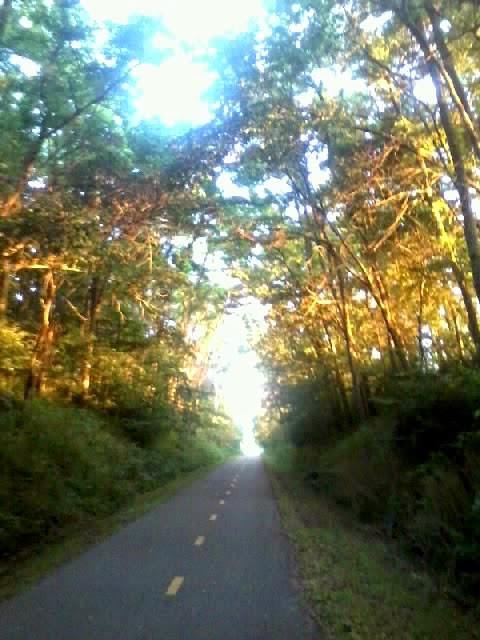
      I am not a religious person so Sunday mornings for me are more often spent in running shoes in the open spaces, communing with nature and pondering all the great mysteries of life. Three or four hours spent seeking a higher level of consciousness is above and beyond what many people do for the sake of their souls on a Sunday morning.

25. Knowing all the running and biking paths by heart 
    That's not to say that I haven't been lost a number of times, but sometimes the only way to find your way is to loose it.  I know all the short cuts, all the cross roads, all the through streets, all the porta-potties, all the drinking fountains in several towns around me.  I have seem more of the state parks and city parks than most people (and sometimes all of them all in one day)  There are beautiful spots that are absolute gems that are often difficult to get to by car, but on foot...no problem.

26. Actually seeing the world and all the wonder that it contains.
     Only when running do I actually have the time to notice people's yards and gardens.  I notice how the river makes a crazy oxbow of a turn.  I run by the Jewish cemetery and see all the small stones placed on top of the head stones to indicate that someone that knew and loved them had been there recently.  Only while running do I notice the progression of housing projects or the completion of a new path.  When I drive in my car, the world goes by so quickly and I am removed from it.  Only running do I notice the subtle changes of the season and smell the different scents of the woods, the river, the lake, the suburbs (hot toast on one particular morning).  "People are on the world and not in it", as John Muir noted.  Running lets me be in it.

0.2  Because I can
       And this reason is perhaps one of the most important of all.  It is the reason that drives my feet in those last 0.2 miles at the finish of a race....because I can.  There are many people that for one reason or another cannot run - cannot stand up on their two legs and sustain the pace needed to run a marathon and so I feel somehow indebted to them and to myself to use this ability and to rejoice in it.  There will come a day when I can no longer do this, but today is not that day....and tomorrow won't be either.



Sunday, November 16, 2014

Embracing the Cold

Daylight savings time hits me at a really bad time.  It usually happens a few days before my birthday each year and the sudden change to early darkness combined with the realization that it is, in fact, getting colder and I am getting older sends my mood into a tailspin.

But this year, I decided to adopt my native Minnesotan attitude.

In northern Minnesota there really are only two seasons - summer and winter.  Summer is perfect for canoeing, fishing, hiking, exploring, and swatting mosquitoes but winter....winter is when the fun really happens.  Skiing, snowshoeing, ice fishing, snowmobiling, hockey, ice skating, curling, you name it and they have invented something fun to do in the snow and cold.

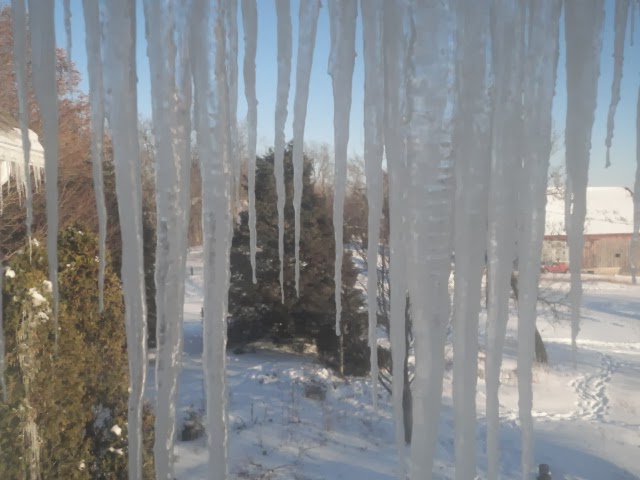
Given the recent plunge into this polar weather, my suspicion is that we are in for a long, cold winter and so, with that in mind, rather than dread it, I am embracing it - the cold and all its loveliness, its fun, its challenges, and especially the escape from it into a warm and toasty house with family and friends to cheer the way until Spring.  Each of the following pictures is a reminder of some of the beauty of winter.


Crisp, cold mornings when the smell of wood smoke foretells of a warm house with a cozy fire. 


 Quiet snowfalls when the earth is muffled and the snowflake crystals glimmer in the lights.


Watching in awe as tiny birds fly about in the deepest of snows and frigid temperatures surviving in a way that I cannot begin to fathom. 


The wake of a big snow storm when the digging out brings people and 
neighbors together for help and assistance. 


The thrill of the hill 
with hot chocolate and the recounting of wipeouts that follow.


Hoarfrost mornings


   Animals and their simple
 tolerance for what is


Roadways that are simply made for skiing or snowmobiling, 
but not really driving


The beauty and brutality that is Winter


Friday, November 14, 2014

Magic Beans

It has been a while since I have tackled a keyboard and attempted to jot down much of anything. I could say that I have been busy, or lazy, or apathetic...all would be true and also none of them are true.  Sometimes I just  discontinue projects for a time and then come back when the mood strikes, or winter does....whatever it takes to find myself with a little more time and a few thoughts to ponder.

In this case it is beans.

"Beans, beans, they're good for your heart. 
The more you eat, the more you fart. 
The more you fart, the better you feel. 
We should all eat beans at every meal."

This little rhyme, sadly enough, is what is typically trapped in my head from about June until sometime in September because one of the main focuses of the summer season is.....beans.

I can't say that beans are exactly my favorite crop (that honor goes to garlic), but they certainly are a useful one.

They are good early in the season as green beans  At this stage we pick them and eat them almost as fast as we are able and the ones we don't eat, we freeze for winter's lean months.  But, if you get busy and don't get them picked, they dry well and then you can eat them that way too.
They are a forgiving crop and ridiculously easy to grow, and in my life, that counts for a lot.

Beans come in more varieties than I would ever care to name, but there are somewhere in the neighborhood of 40,000 different varieties of beans.  Of course you wouldn't know that living in Iowa....here there seems to only be one....soybean.

Personally, I grow three different varieties - two of them I plant on purpose (one pole and one bush) and the third one is a freelance pole bean that self seeds and sprouts every year and then I just transplant it to where I want it to grow.  My main producer, however is the bush bean known as Black Valentine.  It is a dual purpose bean that makes nice green beans as well as a wonderful dried black bean.  What is the difference between a bush bean and a pole bean? One grows as a bush and one will trail and spiral its way up a tall pole.  In tight spaces the pole beans are nice, but when you have more space and don't want to have to deal with a pole or trellis, bush beans are optimal.

When asking people today where they get their cooking beans, I am almost universally met with a blank stare followed by some line amounting to, "well, we just use canned beans from the store," and then they look at me as though I am just not quite right in the head, I mean, where else would a person get beans, right?  Once again, people have forgotten how ubiquitous beans used to be.

Beans are one of the crops that have been cultivated the longest.  Native Americans would grow them together with corn and squash in a "three sisters" planting - using each of those three plant's best qualities to help the other two grow well. The colonies, and particularly Boston, perfected the baked bean.  From the colonies they were hauled overland in covered wagons and were a large percentage of the diet of the early pioneers - they were high in protein and fiber, transported well, grew well and could be saved for incredibly long periods of time. No cowboy dinner would be complete without a plate full of beans, and what kind of Mexican restaurant would it be without refried beans on the side?

 But chances are, if I put five beans in the palm of a person's hand today, they wouldn't know where to start with growing or cooking them.

So let's start at the beginning.  Someone gives you five magic beans....what do you do?


These beans - they are a fairly large seed in and of themselves.  Easy for even small children to plant.
1/2 - 1 inch down in the ground and roughly 6 -8 inches apart.

Keep them weeded.  Invite your friends to help.

Pick them green when the pods are long and full, but before the seeds inside start to mature.  They should "snap" easily in half - crisp and tender.  At this stage they can be steamed for 7 - 12 minutes until they are bright green and just slightly tender.  Seasoned with salt and butter, they are likely the first vegetables to be devoured at dinner.

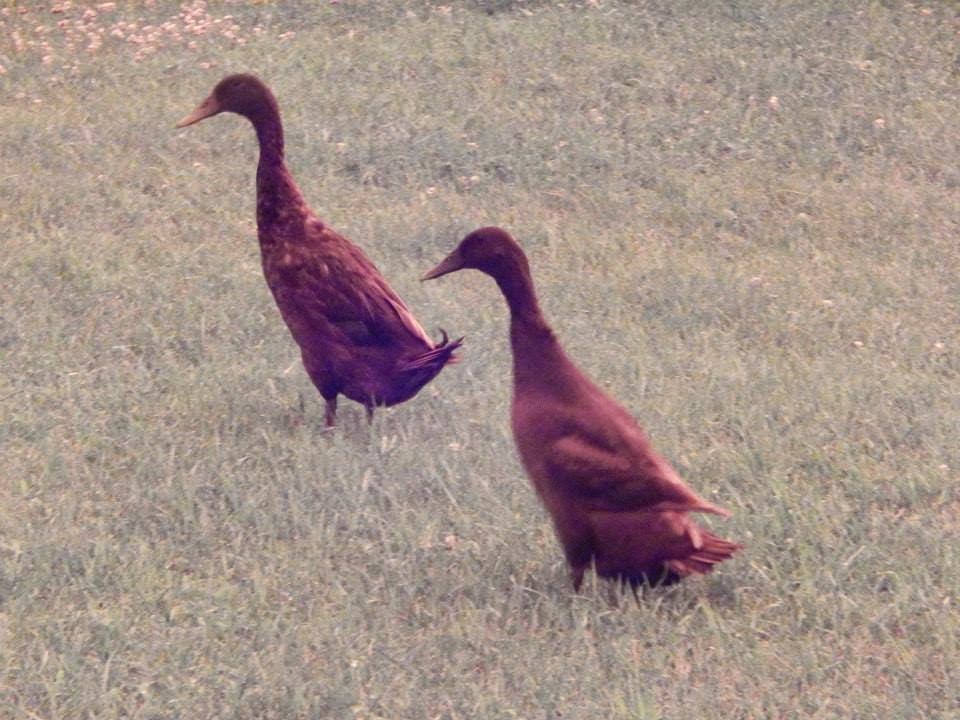
Miss a week or two of picking the green beans, but keep the weeds down and then let the pods start to turn light tan and dry.  If you thought you had a lot of green beans, just wait until the dried beans start to show up.  I usually give myself some sort of limit as to how long I will pick each day.  I typically pick one pillowcase sized sack full any time I have a free hour or so.  This is when that little rhyme sets up shop in my brain and refuses to leave until I find myself simply singing it while kneeling in my bean patch.... this can become a monotonous job, but then again, watching a sun set or watching a summer storm quietly build while picking is more meditative than monotonous. And communing with the bees and the beetles as well as the occasional visit from my ducks waddling through would often make this one of the more contemplative jobs that had to be done.


After each picking, I dump the bag's worth of beans out on my porch to dry. And by dry, I mean the pods have to be so dry that they crack open with relatively little pressure and reveal a dried, black (or brown, or spotted depending on the type) inside. Sometimes this drying takes a day or two and sometimes weeks.  It is also largely dependent on whether or not I have time to deal with them - beans drying in the sun are amazingly patient.

When the time is right, pack them back into the bag you picked them with....I know this sounds redundant, but bear with me.

Jump up and down on the bag and then dump them into a large bowl or pail. (My littlest kids think this is great fun) Set up a large house fan on high and, while standing in front of the fan, slowly dump the beans from one pail into another with the air blowing away the chaff.  This takes time, but slowly, by crushing the remaining pods and winnowing out the chaff, a hill of beans will emerge.  I can usually spend an evening winnowing beans on my porch and end up with 3 - 5 pounds of relatively clean beans by the time the sun sets.

At this point I usually take the bowl of beans into the house and find a movie that I know by heart and sit down to sort through them by hand to pick out the "bad" ones.  This is a completely mindless task, but one that, for one reason or another, is also very soothing - probably because the "finished" beans are so pretty and fun to sink your hands into.

I know....I know....this is a lot of work for a measly hill of beans, but now...those 5 magic beans have become hundreds (if not thousands) of beautiful, protein rich beans that can be saved and eaten through the winter in soups, stews, or even as a most amazing black bean dip.  On average, for a family of 7 people, we will have several gallon jugs filled as well as a 3-4 quart jars.  These, then, become the staple in chili, ham and bean soup, black bean dip and baked beans.

To cook:  Take 1 cup of dried beans and cover with water - place in the fridge overnight to soften. Then, to cook, put in a pot with water and boil until they are soft being sure not to let the water completely boil off.  Drain the beans (or don't - depending on the recipe) and use in whatever bean recipe strikes your fancy.  This really is ridiculously easy but it does require time and a little planning ahead.

Black Bean Dip
   1 cup black beans boiled and soft 
(reserve some of the fluid they were boiled in)
1 -2 cloves of garlic
fresh cilantro
salt to taste

Mix the cooked black beans and roughly 1/2 cup of the water they were boiled in, the garlic cloves, cilantro and salt into a blender or food processor and mix until smooth (adding more water if necessary to make a bean dip consistency)  Salt to taste and eat with tortilla chips.

I make a batch of this and it is gone before it has time to cool off with hungry kids around.

These beans, these magic beans, are magic in so many ways.  Not only do they provide and incredible food source, but while they are growing, their roots bind nitrogen in the soil and help it to become more fertile.  They are a restorative crop and one that I plant in areas where the soil was plundered by other crops the last year - crops such as corn which are horribly greedy plants that strip the ground of its nutrients to produce a huge plant that supplies only 2 small ears of edible goodness.  Beans, relative to their size produce more edible produce than many of the other plants in the garden.

 Yes, they take time to plant, and cultivate, and harvest and dry and process and cook.  But there is some magic in that time as well  - sunsets watched, rain clouds rejoiced, bees observed, kids laughing and playing rhyming games while weeding, a teenager helping to make bean dip- a connection to the earth, each other, the plants and the food that you grow and harvest with your own hands.  There is a strange sort of connectedness in that process.

Not only do they feed the ground and the body ....they feed the soul.  Magic indeed.


Sunday, May 11, 2014

Free Food

Every spring I am rewarded for my laziness. While many gardeners and farmers clean up their gardens before the first frost, I become my usual slothful self and decide that I would rather spend what little energy I have left freezing and canning my garden's bounty and skip clean up all together.

It pays off in the spring.

But you have to be patient and pay attention.

All too often in the early spring, I would be in such a hurry to get the garden clean and tilled and ready to plant that I would miss all the food just waiting for me.  I would plow it under before it even showed itself.

Every fall, that lettuce that you didn't take the time to uproot....it goes to seed.
Those cucumbers that you neglected after you had enough pickles made and stored....they went to seed.
That spinach that bolted and became too bitter to eat....it went to seed
That somewhat rotten onion that you didn't want - it sprouted again and is now beautiful
The garlic that you didn't pull....it's back and bigger than last year.
The parsnip you forgot to dig up - they are sweeter than ever now and ready to eat.
And so is that carrot!

And not only that, but Mother Nature is the best almanac for when to plant things you will ever find.  In general, when seeds are naturally sprouting outside in the cold spring, it means those seeds can handle it, so if you want to start neat and tidy rows of food, you probably can - even though the almanac and the seed packets may say otherwise.

There are all kinds of wives tales about "what is the best time to plant _____?"  For corn it is when oak leaves are the size of a squirrel's ear.  I don't know how many people have actually even seen a squirrel's ear?  I tend to just wait for the random forgotten ear of corn to suddenly sprout into action.  Even after a long, sub-zero winter, it will happen.

This is, of course, provided you use seeds that haven't been genetically modified to only sprout once.  Heirloom quality seeds or organic seeds cost more, but they will more than pay you back in their ability to produce fantastic quality foods with minimal work (or in this case, no work), year after year .


So, while other enterprising gardeners are busy cleaning, tilling and planting, I am busy harvesting the fresh spinach and lettuce from the garden - the first crop of greens so long awaited in the many months of cold.

 What we don't immediately harvest and eat, I transplant into more recognizable and organized rows.  The transplanting slows it down a bit and extends the season for a few more weeks.

So many times while gardening I have marveled at man's belief that we know what we are doing and are "in charge" of growing food.  While it is true that we are the caretakers of the produce, Mother Nature already has the system down and knows the perfect timing and temperature for it all.

Wednesday, February 26, 2014

Sometimes It's Cold

It's cold.

It's freakishly cold, and what is worse are the people who keep saying "It's cold!" as though this is something that they can't fathom happening in February in Iowa.

"No kidding?" I say as I go out for a run, or clean a barn in the sub zero weather. "Well, we had better get used to it.  And while we are getting used to the cold, we better be good with draughts, tornadoes, floods, earthquakes, and tsunamis as well."

I think my patience for people is running very thin right now.  I have moments when I can see how people completely snap and feel the need to cause a scene, if only to have their message finally get out there.  Individually, most people seem to get it, but collectively we are a bunch of dunces when it comes to figuring out how to make a change.

An example that pops into my head this morning came from a client of mine.  He and his wife run a small business in our local town and are two very wonderful people, kind, and well versed in supporting the community. Myself, being the veterinarian for their pets, gave them a recommendation for a medication that can drastically help their pet and the offer to have that medication filled immediately at my office, they opt instead to go shopping on-line.  Now don't get me wrong, I understand the desire to save a few bucks as much as the next guy, but here's the thing….when faced with small business owners struggling to make ends meet (which, you will remember, these clients are as well) or big box stores that undercut us in costs and monopolize all the product so that we end up having it back ordered for months at a time….which one is likely going to help the local economy more?  Seems pretty simple right? You go with the small business owner.  But time and time again, people know what needs to be done on a larger scale, but when it boils down to the individual they think, 'I'm sure there are others buying locally so if I save a few dollars, it won't be a problem'.

It's a problem.
It's a big problem and it is only getting bigger.

Every dollar spent is a vote for how we want the world to be….every dollar.

The increase in farmer's markets, healthy food, and small cooperative grocery stores has been a bright spot, but the blow back from the large food companies has been huge - the advertising and marketing campaigns alone have been enough to boggle the minds of the average consumer to the point of throwing up their hands and saying, "Oh, what the heck! I don't know what to eat anymore so I will just go get a McRib and a shamrock shake!" …..game, set, and match for big agriculture right there and quietly another organic farmer goes bankrupt.  People vote with their forks three times every day, and every meal counts….every meal.

Is it that people understand it, but just don't think it applies to them?  Or are they so easily confused and mesmerized by fancy advertising? Or maybe they are just too tired from working their three part time jobs to make ends meet that they just don't have the time to do the necessary research to understand the issues.

I spent the evening last night watching Brooklyn Castle with my kids.  A documentary about kids in a 'below the poverty line' school learning chess and winning national championships.  Sounds crazy, but it was impressive and such a fantastic way to keep these kids engaged and learning in all of their subjects.  But like so many schools these days, their funding is being cut. Why? Where does this funding go? ….to pay off wars?, to cover for the many bad decisions of bankers?  Cutting educational funding is the most ridiculous thing a country could possibly do. It is like having the makings of a star athlete and then cutting off his legs.  Children are the investment in all of our futures, and we can't stand idly by with our hands in our pockets and say, "but I don't want to pay taxes anymore! We need a tax break!" What we need is an equitable tax that helps support education to its fullest degree. And please don't hit me up with the "charter and private school" theory or we are right back to the top paragraph with the "big box stores/ controlled by corporations" discussion because eventually, that is where a lot of those schools end up - funding coming from large corporations or sponsors that can foot the bill and control what the kids ultimately end up learning.  Public school - as in sponsored by all of us, for the education of all our children is still the best and most broad base start we can give them.  Every kid will one day have a say in how this country runs…..every kid.

Okay, so my little rant is over, call it cabin fever, call it my pressure valve so I don't go out and completely loose it with the population at large.

When it comes to this weather, we get what we asked for, in my opinion.  I know I can send off any number of letters to Congress and the President, I can shut off any unnecessary lights in my house, I can contact the utility company and opt to pay more for the renewable energy, but until
every single person stands up and says, "No more coal and oil! No more fossil fuels! Renewable energy only!" - until that point, there will be enough muddying of the water by the coal/oil/gas industries to keep people confused and questioning, there will continue to be lobbyist money that gets passed across (or under) the table to our "elected leaders" and there will continue to be environmental changes that we are not equipped to handle.  Who knows, before long maybe Hell really will freeze over.

Until then….bundle up and stop complaining.

Tuesday, December 31, 2013

Four Dollar Wedding

It was the fall of the year 1932 and group of young people were ambling down a road and spending the evening together talking of local events and people they knew.  One topic of discussion that came up was the elopement of a young girl that had been engaged to another man, and another was one of the ladies bemoaning the fact that her husband had forgotten their wedding anniversary.  Amid this group of young people were two people that would come to have great significance in my life.  One was a young woman of 20 years named Vera, and the other was a young man of 21 years named David.

David overheard Vera talking with one of her friends and, as the topic revolved around marriage and anniversaries, she made the comment that she never wanted to be engaged.  She made the statement that if a reasonable looking fellow showed up with a license and the next day was New Year's day, she might just consider getting married, because then if he forgot the day, at least she would have reason to celebrate anyway.

Being small town, South Dakota in the depression, much of the entertainment for the young crowd included spending time together in the evenings, talking, dancing, and catching a movie when one could afford to.  David and Vera had spent several such evenings together, but no formal discussion of marriage had ever come up.

Vera was working as a teacher's aid in the local school and bringing in $6.25 per week at the worst of the depression. That small salary is what kept her parents, sisters and brother from going hungry.    David worked on the family farm doing what he could to help provide a living for his family, but the times were so bad that typically only one person in a family or couple were allowed to have a job in order to ensure more jobs to go around within the community.

As the fall wore on and slowly turned into winter, David was busy repairing the family car - a Nash coupe and decided to take it for a drive on Saturday, December 31st.What thoughts must have occupied David's mind during that snowy drive on solitary country roads, one can only surmise - 'height of depression, maybe it would be better to wait until times improved, but then again, when you are at rock bottom there isn't anywhere to go but up, I love her but will that be enough to sustain us, or will I even be able to make a living for them?' It was forty miles later, in Faulk county, in the county seat of Faulkton, when he bought a marriage license for $2 and then purchased a ring at the drug store.  Another forty mile drive home again with as many thoughts and fears to occupy his mind, and he tucked the license and ring into a safe hiding place - in the handhold of one of the monocoupe airplanes in the hanger.

Vera and David with their first born son (my uncle)
That evening, he took Vera for a ride and they stopped out at the hanger.  He showed her the license and pointed out that the next day was New Year's Day.  If she was so inclined, he thought they might get married the next afternoon.  Maybe she sensed the proposal was coming, or maybe it was a surprise, but either way what thoughts and fears Vera faced, is hard to imagine - 'key provider for the family, what will they do without me?, Do I really love this man enough? When you are at rock bottom is there anywhere else to go but up?'  Whatever her thoughts and fears were, she must of thought he was a reasonable looking fellow, because she said 'yes'. 

Sunday, January 1st 1933, after lunch, David asked his dad if he had any money he could borrow. His dad gave him two dollars….all that he had with him.  With the little money that David had saved and the $2 from his dad, he picked up

Vera in his 1926 green Chevy coupe and they lit out for Faulkton.  They had to keep the marriage a secret because they knew that if the school district found out that Vera was married, she would loose her job.  They were married by the minister with his two children standing in for witnesses.  David had planned to pay the minister $5, but realized that the amount of money he had was pretty slim.  He paid him $4 instead and then they went for hot beef sandwiches and a movie in Highmore before heading home for the night.  When all was said and done, they had $1 left to start a marriage on.

They kept their marriage a secret until May and on the last day of school, Vera skipped out and left a note saying she would accept the last day of school off as a wedding present.  David and Vera left that night for the Black Hills,  their honeymoon and many happy years of marriage.  Those two young people were my paternal grandparents whose sense of optimism and adventure in the face of a depression have left inspiration in their wake for all of their descendants to come.  They were together for 72 years….that may have been the best $4 investment grandpa ever made.

Saturday, December 21, 2013

The Darkest Day

I started a new tradition with my kids a few years ago. In the summer, when the weather is reasonably good, I take the oldest ones up to northern Minnesota for a little camping.  We find the remotest location possible within a State Park and set up housekeeping in a tent for three or four days.  We sleep on the hard ground, we eat food that has been warmed up over a fire and we explore the area in the hopes of seeing large and potentially dangerous animals (at a distance).  I mention this here only as a prelude to my train of thought. This camping, although rustic, is far from primal - we have an easily built fire, we have mostly prepared foods, we have a car in which to drive away if the weather turns foul, but it allows my kids to see how easy life really is for us most of the time.  This last year, I brought along a flint striker and let them set about starting their own fire.  After nearly an hour of attempts there had been only a small fizzle of flame and the need for sustenance outweighed the basic skill set of building a fire without an easy spark, and the matches were brought forth.

Camping in the woods with my kids makes me think about what sort of conditions humans survived for thousands of years. A daily job of finding shelter, food, and warmth….that's it, day after day.  No house to mortgage, clean, and repair.  No cars to buy, fix, and drive.  No jobs to employ, tax, and stress us.  Just life, simple and basic....and extremely difficult.  I like to think that, if push came to shove, I could survive better than most out in the elements.   I think about what I would need first - shelter? food? and what would be the best way of obtaining these things.  I realize that this is likely a silly thought experiment given today's world, but it and the time of year that we are in lead me to the following question:


Who originally figured out the solstice timing?

There are countless festivities around this time every year - almost every culture has some celebration or feast, but who was the first?  Early neolithic cultures in England come to mind with their stone circles that have been assumed to be related to the solstices, but the builders of Stonehenge weren't necessarily first, they just built a great huge rock configuration after they had it worked out.  What fascinates me is wondering who was the first person to take a moment in their daily drudgery and say, "is it me, or are the days getting shorter?"  At what point did homo sapians advance enough to notice that the days quietly got shorter until approximately now and then slowly begin to get longer again?

Every year, as each new season happens, I have to stop and think, "did it happen like this last year?" I marvel anew at the first green sprouts, the warm breeze, the turning of the leaves, the first snow….it is as though I have no memory of the season specifics that I have lived through for the last forty years. And the sudden realization that the nights are getting ever longer catches me completely off guard when I walk outside after work and realize I am standing in twilight.  This realization that the days are getting shorter always fills me with a certain amount of gloominess.  How much more might the first people have felt this gloom slowly engulfing them?  It must have felt like the end of days at times and for many it probably was - starvation was a fairly common form of population control and the cold weather did not make survival any easier.

What I find interesting is that among most of the cultures of the world, this celebration appears to have developed independently of one another.  There was no newspaper, no television broadcast to announce a discovery of the day upon which the earth took off again for another 585 million miles around the sun, no universally agreed upon moment of relief in which the world would heave a collective sign and think, "oh, good! We are on course for another year!"   And so, each region and culture developed their own set of beliefs and story for why things are the way they are - each slightly different, but with a common thread…..light.

Regardless of the origins, the celebrations ring similar in more ways than they are different - The coming of the light, whether it be in the form of a person or the return of the sun's warmth to the earth.  They all celebrate a subtle shifting of the earth and all its inhabitants that promises renewed hope for the future.  So, this year, whether you light a candle on a menorah, decorate a Christmas tree, burn a yule log, celebrate Kwanzaa, or light a candle and say a quiet "thank-you" to the earth and sun, remember we are all in this Earth together for another spectacular 585 million mile ride around a distant sun. The darkest day is here, now let the light come in.

Peace.


Wednesday, November 20, 2013

Tan Your Hide

Many of us grew up with it, the threat of "I ought to tan your hide" when we did something unspeakable.  I am beginning to think that this threat was never actually uttered by anyone who really had tanned a hide because, frankly, given even the worst infraction by a kid possible, "tanning" is simply a lot of work and likely more of a punishment for the person doing the tanning.

We have established a strange pattern  on our small livestock farm.  When some beloved, fur bearing, food animal either dies unexpectedly or is sent to market, we have taken to tanning their hide.  Now, granted, we are at a sum total of two at the moment, but once bitten by the tanning bug, it becomes something that you consider every time you run your hands over a soft furry, or woolly back.

The first time this thought even crossed our mind was the day that our beloved sheep, Lambie, died suddenly of heart failure.  It is a terrible conundrum, really to happen upon an animal that you loved as both a pet and a potential farm contributor who has quite suddenly died from an apparent heart attack.  What's to be done?  Bury her and loose all the good meat and wool, or butcher this poor hapless family member that also just happens to be a sheep?  While we deliberated this ethical and moral situation, it was deemed best that we at least start the butchering process because there really is only a small window of opportunity for that process to take place.  Grieving would have to take place while wielding the sharp knives and bone saw.  The skin, of course, is one of the first things to be removed and Lambie had such a fine coat of wool that I was sad to see it, too, go to waste.  Around here, one thing leads to another and, thanks to a few quick references, the initial scraping of the hide was underway.

Salting the hide
There is a strange sort of alchemy that happens when butchering an animal.  Chickens can quickly be turned from feathered friends into rubber chicken-like models, and then into an incredible bowl of chicken noodle soup with a mere flick of a knife, and some really hot water.  Sheep convert from a large, belligerent, somewhat spastic animal into a fleece and a significant amount of red meat very quickly.  I am not suggesting that there is not true affection for these animals, or that we are blood thirsty individuals - quite the opposite really.  Killing an animal, for whatever reason, but especially if we are going to be eating them, is a very thought provoking process in which there is a lot of introspection and palpable gratitude expressed to the animal.  The day Lambie died, Keith and I really did not talk much to one another, both lost in our own thoughts, grappling with our emotions surrounding this farm life altering event, but understanding the time sensitive nature of the material required us to put it all on hold for the time being.  In Lambie's case, we were spared the necessity of trying to decide when, or how we would ever send her to market.  She did it for us, bless her little weak heart.  And just to be clear, before I get a lot of worried responses to the effect of "that meat may not be safe to eat!"….yes, yes it was.  Being the vet that I am, I sent off multiple tissues samples to try to determine the cause of the sudden demise of our entire herd of one.  Turns out it was White Snake Root poisoning - a type of plant that was in our hay that we didn't even know about…. but that is another post for a different time, I digress….

 Lambie was a hand off from our neighbor who had a set of triplets.  She was the one triplet that wasn't doing well because she didn't get any milk.  Our neighbor, also being the school bus driver, knew that we had a lot of kids and a mom who was a vet.  It hasn't taken long for the neighbors to realize that we are a good place to drop the rejects - we are like the island of misfit farm animals.  Lambie, when she first came to us, was not even able to suck from a  bottle so had to be tube fed for three weeks until she learned to eat the new spring grass that was finally growing.  Because of the cold weather, she lived in the house with us for that time, often to be found sleeping behind the door of the mudroom curled into a small ball of warm, black wool.

So it was this now white, fleecy pelt that we skinned off, scraped cleaned and then salted.  These unplanned events never happen at an ideal time, but in Lambie's case, she picked a good day.  Cool temperatures and I was home from work.  What a way to have to spend the day off.  We tracked down a few references for what we were doing and set to work.  The basics are the same for any skin or pelt.

  1. Scrape clean of any muscle tissue and fascia (and hair or wool if you don't want it)
  2. Salt the skin well to help dry and preserve it
  3. Pickle it in an acidic salt brine
  4. Tan it
  5. Oil it 
  6. Break down the fibrous connective tissue in the skin as it dries out to provide with a soft, workable leather. 
This all sounds straight forward, but it can be very cumbersome working with a hide.  They are incredibly heavy and unwieldy, not to mention smelly and somewhat gross to begin with.  Lambie's hide went well up until the point of breaking down the connective tissue in the skin while it dries.  We set the hide out thinking that it would take several days to dry, but it dried too quickly and left us with a stiffer leather than we wanted. 

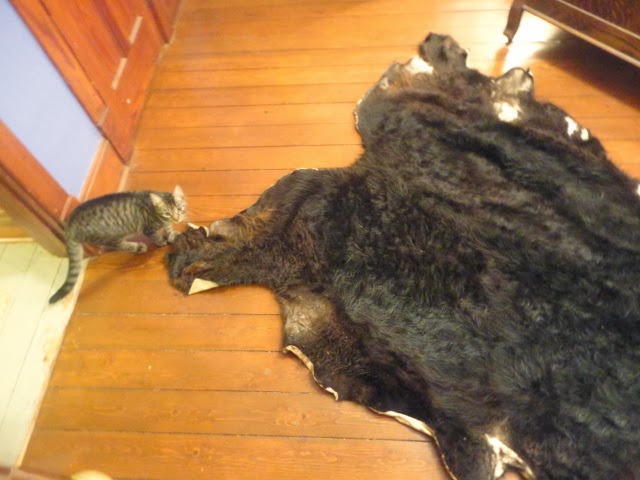
Undaunted by the less than perfect tanning of the Lambie hide, she now covers one of the chairs in our computer room and is fantastically comfortable and warm. And when I threw my back out some time back, she pillowed the hard floor I slept on and made it far more tolerable .  Somehow the hide has still retained the name "Lambie" so, rather than saying, "hey, go grab the sheep skin rug to lay on", it is simply still, "Go get Lambie" as though the soul and spirit of the animal is somehow infused into their skin.  I am not actually sure what to make of this connection and can't decide if this relationship to a formerly living creature is healthy or not.  While I have been pondering this a bit longer, we have started on Harold's hide.

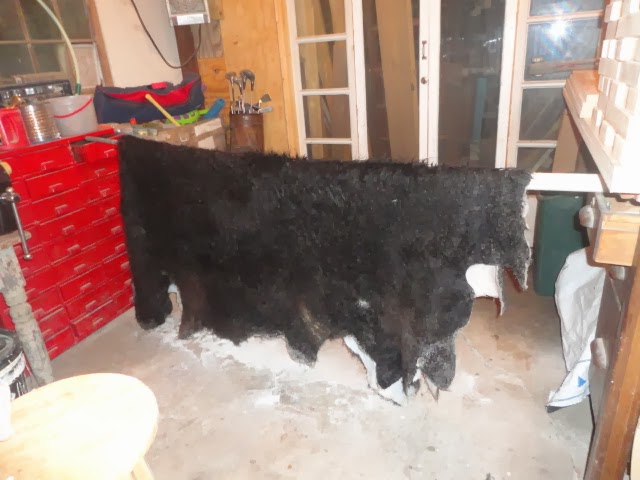
Harold was another castoff creature.  A poor doing calf from the farm down the road.  He was apparently three weeks old at the time we got him but he didn't weigh more than 25 pounds.  Probably premature or lacking in some important genetic component that stunted his development significantly, Harold spent the first three months of his life just learning how to eat.  Bottle feedings were hopeless, he never did figure out a bucket, and it would take him an hour to eat a small amount of grain.  Green grass saved us once again and slowly he figured out his natural food and took to it with relish. That's not to say he ever really grew much.  By five months old, when most of his contemporaries were several hundreds of pounds, he topped out at 124 pounds.  By his first year, when he should have been about the size of our two year old dairy cow, he was half her size.

Cute and fuzzy, but not entirely all there, his small stature would sometimes make him look as though his internal organs were going to pop out of his small skeletal frame.  By eighteen months, when it became apparent that he was no longer growing any bigger, only wider, the decision had to be made.

Pasture is always at a premium around here, as is hay in the winter.  The options were to send him to market before winter hit, or in the spring…..given the hay situation, the answer was made for us.

Market day is always a sad day around here, and this year was no different except it was also my birthday.  We had decided just that morning to go ahead and get the hide back so we could tan it, and it only dawned on me later that this meant I was likely going to spend some part of my birthday scraping muscle and connective tissue off a newly skinned hide from an animal that I had loved and reared. Some people go out to party…..others flesh hides.

Repairing small holes
Acid bath soak
I could describe the entire process, but I would do a poor job of it at best because the actual process is long, involved, and usually split between Keith and I, with Keith doing the lion's share of the heavy work.  There are many good references available and websites from which to get the tanning chemicals needed, such as Van Dykes.  Having re-read these instructions myself just now, I chuckled reading the last section about the breaking stage on cattle and buffalo hides where it says, "Good Luck! This will be a difficult process."….they aren't kidding.

One thing is abundantly clear when working a hide, Native American women were incredibly strong! Much of the scraping, tanning, and breaking of hides was up to them and this is a process that takes days of hard, back breaking labor….and they were working with buffalo hides to boot! As someone who has spent several hours in the last two weeks working a hide in one fashion or another, I will attest that there are muscles in my arms, shoulders and back that I didn't know were even there, and I have blisters in places on my fingers that I didn't even know could blister.

Stretching the hide
However, as taxing as this job can be, it is also very methodical and mesmerizing.  I will be out in the shop listening to the radio while slowly scraping or breaking the hide and the whole circle of Harold's life will play itself out in my head and there is a quiet sort of thankfulness that emerges when I think of how we will have a part of him around to use and enjoy.  It's difficult to put in words really, without coming across as a total freak, but the hide speaks to a person when you take the time to listen, just like the earth does when you are busy growing food, or the trees do when you walk among them.  There is just a simple expression of wonder and infinite mystery that surrounds anything in nature, whether it is animal, vegetable, or mineral and when it is held in respect and deference for its small part of the whole,  it transforms an odious, back breaking task into a transcendent celebration of all of life.

My guess is that our cow hide will continue to be known as "Harold" regardless of where he ends up residing in my house…. and I am completely all right with that.


Followers