Four Mapels

Thursday, March 29, 2012
To Russia (And Elsewhere) With Love
One of the most fascinating things that I have found about writing a blog is tracking its audience. Don't get me wrong, this system is in no way exact - I have no idea of who actually is reading, but only a very general idea of where they are from. I have noticed that for some time now I have had readers (or reader) located in Russia, some in Germany, some in England, and a few here and there scattered over the globe. It would be wonderful to have some comments posted from readers from other countries and if you are concerned that your English isn't very good....no worries, because I guarantee that my Russian, German, Portuguese and Thai are much worse than your English ever could be. We are one global nation thanks to this lovely Internet, and I, for one, like to know my neighbors.


Tuesday, March 27, 2012
Standing Stones
 Nature in all its many facets is astounding. In Spring I revel at all the new flowers and plants that bloom, I sit mesmerized while watching honey bees and other insects going about their busy lives with no thought for us whatsoever, I am fascinated by watching migratory birds return year after year to nests that only they know how to find, and I even harbor great affection for the rocks.
Perhaps the quietest members of my garden, there are many rocks that line my flower beds and get moved slightly from place to place as I weed around them throughout the year. I like the feel of them, their heft, their rough edges and sharp angles. They are the oldest things here - limestone, granite, sandstone, quartz, geodes- they speak of a time that I will never know. A time of heat and turmoil. Pressure and seemingly infinite spans of time. There are small trilobites that I find embedded in the limestone rocks, whole generations of a species that, at one point, thought they were the height of civilization as we do now.
 For whatever reason, I have a fascination with standing rocks up - a change of perspective for them, I imagine. When I find a small pile of them lying around, even though they may have odd angles, I take on the inherent challenge of balancing one upon the other. It takes a little time and patience to get them to all work together, and not enough can be said to praise a small amount of sand that helps create the all important friction that holds the odd-angled rock in place, but when they are all in harmony and supporting one another, they almost seem enlivened somehow. Even a rock wants to be something - whether it be a quiet meditative being lying in the midst of a field, a part of a building's foundation , or a member of a cairn. Perhaps that is being overly anthropomorphic, but then I try to imagine what the animal world looks like to a stone - we all must be in high speed motion to them, flitting from place to place, growing, aging, dying within a blink of a rock's eye. How ridiculous must the work-a-day world seem to a rock.
 Sometimes they fall. Gravity, rain and wind work their change on the rocks just as they have for millions of years and I will come across the dismantled pile looking like so many pieces of puzzle and stoop to rebuild them again as I take a break from the endless pulling of weeds. No two piles are ever the same, but then it is fun to hear people's remarks that have seen a group of stones together and then realize that they are subtly different, as though by magic they have shifted themselves. Sometimes, I think they do.
Tuesday, March 20, 2012
A Most Unusual Cat
"...He had been gardening again and held in one hand the kind of wide-bladed, lime-green grass that grows at the untended edges of sidewalks and lawns. He shook the dirt free, pulled out a half dozen of the longer strands, smoothed them, then twisted them into a flimsy green braid.
'Time', he said, holding up the braid to me. He indicated one end, then the other, 'Maybe one thousand year.' He touched the individual stalks of grass tenderly. 'Souls, Spirits. You see? You, your father, your mother, sister, wife, children, you see? Your spirit is together with their spirits like this, tight against each other. That is why you were born into this [l]ife together. He pulled one strand out and tossed it up into the sunlight. 'Maybe one of these people, or two, not so close after this [l]ife. But people you really love, spirits that are close to your spirit, you see? They tie around tight to you, [l]ife after [l]ife."
-Breakfast with Buddha by Roland Merullo
I read this book several years ago, but this was a part from the book that entered into my mind upon getting to know Vincent. Vincent is a cat and I am quite sure that he has become one of the strands of grass in my braid of time.

Vincent came to the farm slightly over a year ago. A feral cat, wild and frightened of anything and everything human. Only enticed closer by the lure of food that is left out nightly for the resident clowder of cats. He would wait until we had put the food down and then would warily creep into the mob of cats and grab a few furtive bites before any move on our part would send him flying. Skinny, crumpled ears, and starving, night after night he would get just ever so slightly braver until finally, after many months of very slow and patient work by my kids, he let one of them touch him. Always only afraid, never mean. Cats have two defense mechanisms that they work from when they are in over their heads - they become incredibly ferocious, or they do everything in their power to flee - Vincent was always the second.
At our farm, when a new cat arrives, it is given a certain amount of "breaking in" period before the local vet - that's me- steps in and insists on said cat being a more socially acceptable pet, by which I mean neutered/spayed and vaccinated. Vincent was having none of me anywhere near him even with food available, and carrying a net looked especially worrisome to him. I left the net in the care of my son and within a few days of trial and escape, Vincent came to the door of the house, trapped in the net under much duress just as I was in the process of making pizza on a Sunday night. Time and tide may wait for no man, but neither does a cat in a net. In short order Vincent was anesthetized via an injection in the muscle, tested for several nasty cat viruses by doing a simple blood test, vaccinated and neutered. All while laying on my front porch surrounded by four (and sometimes five) curious kids - my son opted out of watching the neutering process. Anesthetic reversed and by the time the pizza was done, he was completely recovered and had staggered off in the direction of the barn.
 What happened to that cat during that process, I have no idea. From that point on he is always around. He sits just outside the door on the stoop so that you almost step on him when going outside - even in the very coldest of weather. When I go anywhere on the farm, he trots along beside me as though he is a dog trained to heel. When I cook in the kitchen, he sits on the small table just outside my window and monitors closely. The other cats on the farm will drift by and briefly interact with me while on their own personal missions of self satisfaction, but for whatever reason, Vincent seems to have appointed himself as my personal entourage while at home. He loves attention and will purr and roll affectionately around your feet and legs. Gina, my typically cat-intolerant dog, loves him and will actually allow him to eat out of her bowl right under her nose.
 And so I ask myself, who is this little soul that seems to have adopted me? I sometimes peer into his round, furry face as he loyally sits by my side while I garden and think, "Who are you?" and more often, "Who am I to deserve this affection and loyalty?" How can something that was absolutely terrified of all things even remotely related to me, suddenly change and appear to love with such complete abandon? Human beings don't have the monopoly on souls, as far as I am concerned. An animal's ability to love unconditionally so far outstrips our own that at times it is shameful. Whatever the reason, from where ever he came, I hope his soul is one of those that stays with mine for all time.
Wednesday, March 14, 2012
Pi Day
This late winter day finds me completely preoccupied digging in the dirt. I type now with sixty four thousand scratches on my hands from weeding flower beds, smelling of leaf smoke, and my lower back is sunburned from spending the day happily bent over perennial flowers that are starting to emerge. Many thoughts made their way into my head, but most of them were directed at the plants, the earthworms, the birds....no time today to sit and write them all down, but pictures speak volumes.


~Helen Hayes

Until he extends his circle of compassion to include all living things,
man will not himself find peace.
~Albert Schweitzer

The clever men at Oxford, know all that there is to be knowed.
But they none of them know one half as much, as intelligent Mr. Toad.
~Kenneth Grahame

The grand show is eternal. It is always sunrise somewhere; the dew is never dried all at once; a shower is forever falling; vapor is ever rising. Eternal sunrise, eternal dawn and gloaming, on sea and continents and islands, each in its turn, as the round earth rolls.
~John Muir

All through the long winter, I dream of my garden. On the first day of spring,
I dig my fingers deep into the soft earth. I can feel its energy, and my spirits soar.
~Helen Hayes
| |
Tuesday, March 6, 2012
The Benefit of Boredom
One of my favorite things to hear from my children is, "I'm bored." I can usually tell when it is coming because they will hang around me and offer to do jobs for more screen time to play on the computer or watch a movie, which I will often deny. Then they hassle their siblings, pester me more, and then finally it comes out...."I'm bored." To which my only reply is "Good."
 This may seem rather cruel - to enjoy the boredom of your children - but there is an amazing thing that happens to a bored kid....they eventually find something to do. It sometimes takes a while. Usually it goes through the common routine of driving me crazy, driving siblings crazy, driving the pets crazy and then...finally, they launch into something completely original and creative. As a parent, it takes a little fortitude to survive through these stages, but the results are often amazing to observe.
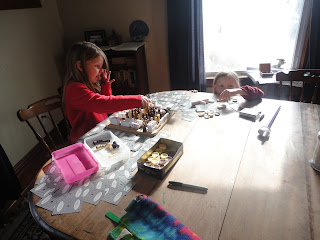 Today, as an example, I was a horrible slug of a parent. Unwilling to even engage my 6 and 7 year old in sorting out their conflicts with one another, I simply listened to their arguments run their course and when I checked in with them this afternoon, the entire table was covered with a mosaic of playing cards to look like a garden and the dominoes had been constructed into some kind of castle. The game that they had devised had rules that only they completely understood, but they were happy as larks to be playing it together. It continued until sometime after dinner (we simply slid it down to one end of the table to allow a place for us to eat) and then they happily picked it all up before bed. At other times I have evicted all of my children from the house to sort out their boredom outside and then watch happily as one of them happens to find a Frisbee and a whole new sort of 'ninja Frisbee-kicking' game is born that eventually involves all five of them in a sort of strange one-on-one-on-three sort of set up with modified two hand touch tackling.
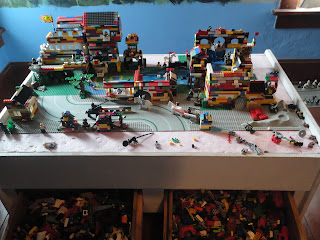 Periodically, I feel bad keeping my children in the technological dark ages, but then again, all that technology is always going to be out there. Like Pandora's box, it has been released into the world and there is no way to contain it again, so they will have access to it and they will have to learn to use it at some point. Entertainment is easy and always on these days, but boredom....that is harder to come by. There are times when I, myself, get caught in a rut and spend entirely too much time in front of this screen and find my mind slowly dissolving into so much mush. Opinions and news stories are all too prevalent, too dramatic, too polarized. A person hardly has time to think for themselves anymore because they are being told so immediately and constantly what to think by news programs and "experts" who, ironically are employed or paid nicely by whoever or whatever they are advocating.
I have been reading a fascinating book by one of my favorite authors, Barbara Kingsolver - The Lacuna which is a historical fiction novel about the time period in the 1930-1950s and deals with such characters as Lev Trotsky, Stalin and the McCarthy era in the US. Her writing is so heartbreakingly beautiful and so thoughtful that there have been times when I simply have to stop and think about what has been said. One of the points that stood out for me is that, at that time of history, the radio was the new media of the day. It was the beginning of the constant barrage of 'the truth as other people see it' in which they would express whatever facts were available, and when the facts weren't readily apparent, they would embellish the truth to fill the air time to avoid a lapse in programming. The whole "Red Communist" scare was mostly a news media fabrication to keep people in a constant state of fear and anxiety and thus listening to the news programing or reading the latest headlines. Not unlike the news programing today. Maybe we should have allowed the lapses and dead air as useful time to think and process what facts were actually available. Maybe we should make time for those lapses now as well. This is one of the main reasons that we avoid technology around here as much as we do. What good has come from it, really? It has made communication easier, but we are so busy with trying to be constantly entertained that we don't effectively communicate with anyone anymore. I love having good debates with people about differing view points - it gets my ire up, but it stretches my thinking, makes me see other sides of the issue, and forces me to state my own opinions as eloquently and succinctly as possible - something the news media doesn't give you a chance to do.
Writing, reading, assimilating, synthesizing and creating something completely new and different are the hallmarks of a populace that can continue to advance. Simply being a sponge and absorbing so much bad news and other people's opinions does not help to make a difference in the world.
 And so, at our house, boredom it is. A lapse in entertainment in which the brain actually has to take in information and do something with it, make something of it, learn something from it. When the brain is thought of more along the lines of a muscle,(rather than simply being a bundle of fatty neurons) - it requires work outs to become stronger. And the brain wants and needs things to think about - as evidenced by the way it wanders while we struggle to get to sleep, or the dreams that it comes up with in the middle of the night. But when we sit in front of a television screen or Wii and are being fed a constant diet of cheap entertainment that requires little more than a rudimentary ability to understand the English language and some kind of reflex activity....well, suffice it to say that the mental muscles are not being flexed. It depresses me to see language being obliterated by 'texting'. Beautiful, thoughtful lines of prose reduced down to "lol" or, if it is really good, "lmao". Our world is now being run on information that is being communicated 140 characters at a time. This depresses me. But, as Pandora found Hope in the bottom of her box, I have five kids who never cease to amaze me with their ideas, creativity, energy, and eventual ability to play well together. They are my hope in this crazy, media driven, entertainment seeking, technological world.
 This may seem rather cruel - to enjoy the boredom of your children - but there is an amazing thing that happens to a bored kid....they eventually find something to do. It sometimes takes a while. Usually it goes through the common routine of driving me crazy, driving siblings crazy, driving the pets crazy and then...finally, they launch into something completely original and creative. As a parent, it takes a little fortitude to survive through these stages, but the results are often amazing to observe.
 Today, as an example, I was a horrible slug of a parent. Unwilling to even engage my 6 and 7 year old in sorting out their conflicts with one another, I simply listened to their arguments run their course and when I checked in with them this afternoon, the entire table was covered with a mosaic of playing cards to look like a garden and the dominoes had been constructed into some kind of castle. The game that they had devised had rules that only they completely understood, but they were happy as larks to be playing it together. It continued until sometime after dinner (we simply slid it down to one end of the table to allow a place for us to eat) and then they happily picked it all up before bed. At other times I have evicted all of my children from the house to sort out their boredom outside and then watch happily as one of them happens to find a Frisbee and a whole new sort of 'ninja Frisbee-kicking' game is born that eventually involves all five of them in a sort of strange one-on-one-on-three sort of set up with modified two hand touch tackling.
 Periodically, I feel bad keeping my children in the technological dark ages, but then again, all that technology is always going to be out there. Like Pandora's box, it has been released into the world and there is no way to contain it again, so they will have access to it and they will have to learn to use it at some point. Entertainment is easy and always on these days, but boredom....that is harder to come by. There are times when I, myself, get caught in a rut and spend entirely too much time in front of this screen and find my mind slowly dissolving into so much mush. Opinions and news stories are all too prevalent, too dramatic, too polarized. A person hardly has time to think for themselves anymore because they are being told so immediately and constantly what to think by news programs and "experts" who, ironically are employed or paid nicely by whoever or whatever they are advocating.
I have been reading a fascinating book by one of my favorite authors, Barbara Kingsolver - The Lacuna which is a historical fiction novel about the time period in the 1930-1950s and deals with such characters as Lev Trotsky, Stalin and the McCarthy era in the US. Her writing is so heartbreakingly beautiful and so thoughtful that there have been times when I simply have to stop and think about what has been said. One of the points that stood out for me is that, at that time of history, the radio was the new media of the day. It was the beginning of the constant barrage of 'the truth as other people see it' in which they would express whatever facts were available, and when the facts weren't readily apparent, they would embellish the truth to fill the air time to avoid a lapse in programming. The whole "Red Communist" scare was mostly a news media fabrication to keep people in a constant state of fear and anxiety and thus listening to the news programing or reading the latest headlines. Not unlike the news programing today. Maybe we should have allowed the lapses and dead air as useful time to think and process what facts were actually available. Maybe we should make time for those lapses now as well. This is one of the main reasons that we avoid technology around here as much as we do. What good has come from it, really? It has made communication easier, but we are so busy with trying to be constantly entertained that we don't effectively communicate with anyone anymore. I love having good debates with people about differing view points - it gets my ire up, but it stretches my thinking, makes me see other sides of the issue, and forces me to state my own opinions as eloquently and succinctly as possible - something the news media doesn't give you a chance to do.
Writing, reading, assimilating, synthesizing and creating something completely new and different are the hallmarks of a populace that can continue to advance. Simply being a sponge and absorbing so much bad news and other people's opinions does not help to make a difference in the world.
 And so, at our house, boredom it is. A lapse in entertainment in which the brain actually has to take in information and do something with it, make something of it, learn something from it. When the brain is thought of more along the lines of a muscle,(rather than simply being a bundle of fatty neurons) - it requires work outs to become stronger. And the brain wants and needs things to think about - as evidenced by the way it wanders while we struggle to get to sleep, or the dreams that it comes up with in the middle of the night. But when we sit in front of a television screen or Wii and are being fed a constant diet of cheap entertainment that requires little more than a rudimentary ability to understand the English language and some kind of reflex activity....well, suffice it to say that the mental muscles are not being flexed. It depresses me to see language being obliterated by 'texting'. Beautiful, thoughtful lines of prose reduced down to "lol" or, if it is really good, "lmao". Our world is now being run on information that is being communicated 140 characters at a time. This depresses me. But, as Pandora found Hope in the bottom of her box, I have five kids who never cease to amaze me with their ideas, creativity, energy, and eventual ability to play well together. They are my hope in this crazy, media driven, entertainment seeking, technological world.
Thursday, March 1, 2012
In Like a Lion
March is upon us and seems to be coming in like a lion....at least from the perspective of my emotions. 
March usually marks the point of "Spring" in my mind and I will likely start becoming overly anxious to be outside every waking moment. I become cagey and frustrated every day that I have to go to work when the weather is beautiful. And, it never fails, the worst days are always the ones that I am at home. There will likely be much gnashing of teeth from now until April and I have a tendency, I'm afraid, of turning into a bearcat with my family due to the confounding weather of March.
 I am still up to my eyebrows in trying to redo one of the bedrooms in the house.....namely mine, and this will likely manage to keep me preoccupied until the ground warms up enough to start moving flowers around and planting seeds in the ground, but that doesn't mean that I won't be staring out the window with my face pressed up against the glass to peer into the gardens throughout the day in the hopes of seeing tulips and daffodils on the rise.
There were also seeds planted indoors today to help reduce the early spring gardening anxiety. One hundred and ten onions, 23 tomato, 12 red peppers, 6 leaks and countless lettuce plants were all started today in organic potting soil and will need to be monitored closely and protected from the threat of house cat destruction until such time as the greenhouse becomes more hospitable (and enclosed) to harbor tender plants. Their planting is like a promise that in the next six to eight weeks the weather will be nice enough to move them outside. Planting them is sometimes a more hopeful predictor of spring than judging whether or not a groundhog can identify his shadow. Watching them sprout and then take root in their small pots is a moving pep talk that, indeed, spring is on its way.

Sunday, February 26, 2012
The Daily Bread
There is a staple in almost every household that just isn't thought about much - bread. Every week requires a few loaves for the constant peanut butter and jelly sandwiches or the toast with peanut butter supply that my children insist upon. A piece of toast and cup of tea has helped soothe many an upset stomach over the years, and rarebit would just be so much cheese sauce on a plate without it.
 When I was in high school, I had a German exchange partner and one of the things that she found most unusual in the United States was the "soft bread" - it mystified her. Only after I spent four months in Germany did I fully understand why. They buy their bread from a local baker typically several times a week and it is a very dense, rich, crusty bread. We would take sandwiches to school because they didn't serve school lunches there, and it would consist of dry bread and liverwurst. At first I truly thought I was going to starve to death, but I sometimes now find myself thinking back longingly on those sandwiches because, as it turned out, they were really good and largely due to the bread.
I have always liked making yeast breads and made quite a few loaves during my early days on the farm, but I have to give credit to my husband as being the main "bread maker" of the house. He took over this job with gusto a few years ago and we haven't seen pre-sliced bread in quite some time now. My husband remarked the other day that we have been eating home made bread for so long that we no longer say, "homemade bread"....it's just "bread". This homemade bread making started with my daughter's diagnosis of celiac disease. Suddenly, bread was the enemy - unsafe for her consumption and we had to find an alternative. There are several gluten free breads that are commercially produced now, but I haven't found any of them that are very tasty, so my husband set out to find a recipe that would work for her and taste good enough for her to want to eat every day at school, because everything (and I do mean everything) in a public school cafeteria has wheat in it one way or another. He also took on the challenge of making wheat bread for the rest of the family as well.

On average, there are between two and four loaves of bread consumed by the "wheat eaters" in the house in a given week depending upon the meals we make. My daughter and I (since I also started to eat gluten free in solidarity with her and found that my allergies and several other chronic health issues completely disappeared as well)...we eat about one or two loaves between us during the week. That can add up to a lot of bread.
Now.....here's a test....how do you make a loaf of yeast bread?
This is something that for countless generations was just known. People (typically the women) made bread all the time....daily. It was probably such a reflex action that I would imagine they would knead the bread in their sleep if they had to, and yet today there are not too many people that would really have the first idea of where to start to make a loaf of bread. Not that it is imperative that people make all their own bread, but it is usually a good idea to know what should be in it. Reading a bread label shouldn't take an advanced degree in chemistry.
The other day while riding in the car with one of my daughters, she happened to mention something about a friend eating Wonder bread. I looked at her and smiled and asked, "You know why it is called 'Wonder' bread'?" My daughter knows me well enough to know that I was not about to say anything favorable about this highly processed and mostly fake food and said in answer, "because we 'wonder' what is in it?" To which I could only smile and nod.
 The Basics:
Warm water
Yeast
Sugar
Salt
Oil
Flour
Anything additional and you start making "fancy" breads. Add some whole wheat flour and make "whole wheat bread", add oatmeal and raisins and you will have "oatmeal, raisin bread" Bread dough is a very forgiving substance, but it does help if the basics are down. Knowing how to proof the yeast, for instance - some bread makers swear by it, others, well....we fly by the seat of our pants. Knowing how and why bread 'rises' or better yet, knowing how to catch and use free-living yeast from the air to make bread is a State Fair trip in the making for any kid. Bread machines are nice, but really don't provide anything extra that you don't already have on hand. They do, however, take out the fun parts of bread making that include punching down the dough and kneading it. One day, while in an especially bad mood, I worked out some aggression on the innocent lump of dough that had been nicely rising. My son happened by and remarked, "Mom, remind me never to make you mad, okay?" Making bread can, in some ways, be very therapeutic.
The best part, by far, is how baking bread makes the house smell. Walking into a house with bread baking in the oven is quite possibly one of the most soothing smells in the world. Warm bread....the very thought of it can comfort the sorest of souls.
The difficult part, for most people, is finding the time to make bread. It has to be mixed and kneaded, then it has to rise for one or two hours, then it gets kneaded again and shaped, then rises a second time for another hour, then baked. This can seem like an extensive process for a single loaf of bread, but when thought of in segments it becomes less odious - mix, knead....play a game of Life with the kids....knead, shape.....go for a run or do chores outside....bake while starting dinner.....then enjoy warm bread with dinner. All together the time spent actually making the bread is about 30 minutes and the time that it has to sit and rise is more of a guideline rather than a set amount of time - if the game of Life goes on for two hours, that's okay because the dough will keep. As it turns out, Gluten Free bread is actually easier in the sense that it only has to rise once and then be cooked. There have been instances at this house where we will have three loaves of bread and two pizza crusts all rising at the same time - we almost need a flow chart to figure out which ones go in the oven when.
 With the majority of the bread being now made by my husband, I haven't had to think of it often, but periodically I am left in the care of his dough as it is rising while he does a few odd jobs for neighbors in the area or runs one kid or another here or there for band or sports practice. This is an honor that I do not take lightly, but I do have a tendency to handle my own bread dough a little differently - every baker does, I think. It becomes more of an art form than food after a while, and we all have our certain way of making sure that it rises as well as it can, doesn't have air holes and stays soft despite being forgotten about by whatever errant child forgets to put it away after carving off a slice. My bread art comes in the form of pizza crust that is made every Sunday evening to be shared while watching whatever family movie we agree upon - our only meal to be eaten while perched in front of the television, but it has become something of a family tradition. Regardless of who makes it, as an art form, bread in all its many forms is perhaps the tastiest.
Thursday, February 23, 2012
Making Do With Nothing New
We have a reputation amongst our acquaintances as being "the last stop before the landfill". I am not sure, sometimes, whether to think of this as a compliment or an insult.....depending upon the stuff, I guess it could be either one. I grew up in a family that was heavily influenced by The Great Depression - stories of living without, re-using, re-purposing, re-making - one of my grandmother's favorite sayings was, "waste not, want not" and she was famous for turning almost anything into something else....my personal favorite was using old plastic grocery bags to crochet them into baskets. After Armageddon, these things will still be around.
What amazes me the most about all this "stuff" is just how much of it there is, and this is the stuff that people don't want.
Clearly, my standards are rather low, but taken in another way....I am very easy to please. I am eternally grateful for any and all clothes that show up for kids because with 5 of them (and all of them true "farm kids"), clothes go by fast. Miscellaneous wood is another one that is very handy to have people drop off....you just never know when you will need to build a shed or put together a project that may require odd pieces of wood or when people will drop by for an impromptu bon fire.
The worst part is that we start to take on a "pack rat" mentality and have to periodically jettison some of the excess cargo that builds up. The biggest times that we have had to do this, of course, is when moving from place to place. We moved so much for a while that we had it down to a science. "Three moves equals a burn" was a common phrase in our house, and we were pared down to only the necessities. Needless to say, when you move to a farm with excess out buildings, the stuff starts to pile up in a big way. My mother always threatened that, when she moved off their farm, that she was just going to lock the door and light the match. Having recently moved my parents off their farm.....this would have been a good idea.
 We have been in this place now for almost nine years which means that there is roughly nine layers of stuff that has built up in many of our sheds. One shed in particular has been a key storage shed - the Quonset hut. When we first moved out here it was a storage shed for my sister's stuff, then it got utilized as the catch all garden shed, then my father stored his Lexan panels in there for his acoustic engineering business, and then one end of the shed was commandeered for an animal shelter to house Hazel, Lambie and the occasional wayward chicken. Now, in a grand attempt to make do, we are turning the Quonset hut into a green house using some of the left over Lexan panels that have been sitting in there for three years.
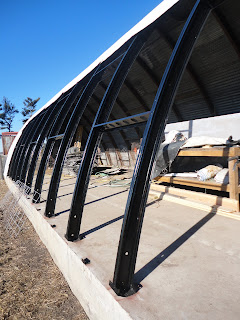 One side of the shed faces due south so the plan to remove the corrugated metal panels from that side and replace them with the Lexan panels seems like a straight forward one....at least to me. However, as pointed out several times by my architect husband....it is never quite as simple as that. The metal panels came off easy enough and are currently being stored in the Quonset hut and idiotically moved from one end of the building to the other when we need to get them out of the way. Hate to throw them out though....they could be used for something else. (See how this gets going.) The metal ribs have been painted from their original deep rust to a shiny black and now we are at the stage of attempting to figure out how to put the panels on. In theory, this isn't too hard, but in reality....these things are really heavy and have to be lifted twelve feet into the air. I have images of going out to find Keith squashed under one of these panels like a bug under a cover slip on a microscope slide. At present, we have two in place and six more to go.
 Using, re-using, recycling, and making do are wonderful skills to have. It kept my creative grandmother busy until she was almost ninety years old, and it has undoubtedly saved us thousands of dollars while simultaneously saving tons of stuff from the landfill. At some point, I have a sense that our society's "throw away" mentality is going to come back to haunt us. The "Wal Mart" mentality, as I call it...."Oh, but everything is so inexpensive at Wal Mart! How can you not shop there?" Easy.....When so many jobs have been shipped overseas and almost everything you buy now comes with a sticker that says, "Made in China" on it, because in China they are willing to work for $2 per 12 hour day so the cost of production and, therefore, the cost of the product ends up being cheaper than any American company could produce it.....and then companies like Wal Mart sell mass quantities of a product for a while, become that product's main purchaser and then they demand that their price for the product be set even lower, so now that company has to produce its good for even less money and the people in China work 14 hour days for $1.50.....that's why I don't shop at Wal Mart....or Kmart.....or Target if I can help it.
I really have nothing against products made in China, they make the products that Americans either don't want to make, or American companies don't want to have to pay so much to have made. However, I try to keep my purchases as close to home as I can. It isn't easy, but once in a while you find a company that still produces a product in America. They aren't inexpensive, that much is for sure, but they are paying American workers wages that support the local economy and they are very often socially conscious companies that make the effort to produce a quality product while simultaneously creating jobs. Imagine what our country would be like if these companies were the ones that we shopped at instead of the Wal Marts? America has essentially become the land of the service industry - manufacturing has become a thing of the past for many, which is unfortunate. Not everyone is cut out for service industries and I sometimes wonder what will happen when China decides that it is tired of supplying us with our plastic Happy Meals toys and 50 inch television screens? Will we have any idea how to produce stuff for ourselves? And will anyone be able to afford it? When I can't find an American product, I buy second hand if possible - yes, it probably came from China, but it is sold not once, but twice (or more) by local sales people.
Believe it or not, there are times that I think back to the stories that my grandparents told me about the Depression and not having so much stuff, and I am somewhat envious. A time when people were all working together to exist in whatever capacity they could, using what they had on hand, relying on neighbors for help when needed. As much of a struggle as those times were, I never once heard a story from either set of grandparents that was necessarily sad. They were stories of dances and playing cards with friends and sitting on fenders of their cars in the middle of town on Saturday nights talking to each other while all the kids ran around and played kick the can. Crazy stories of jobs that my grandpa did to make ends meet - like moving houses or driving a load of pigs to market when the truck tipped over and all the pigs got out. Now what are our stories? "Went to work, came home, ate something in front of the t.v. and then went to bed." ....talk about the great depression.
I think there is a movement afoot - slow but starting to grow - of people that are starting to realize some of this as well, that sometimes less is more, being creative and ingenuitive gives more a sense of accomplishment than being rich does, and sometimes talking and having dinner with neighbors rather than watching the latest episode on t.v. leads to memories shared. Maybe it is due to "The Great Recession" that we are in right now, in which people just don't have the funds to replace or buy things, but I like to imagine that maybe....just maybe, we are waking up to the idea that want and need really are two different things and sometimes, when the wants can't be had, it allows a little space for something else to come in instead - creativity, interaction, memories made. Maybe that is what my grandmother really meant, "Waste not. Want not."
What amazes me the most about all this "stuff" is just how much of it there is, and this is the stuff that people don't want.
Clearly, my standards are rather low, but taken in another way....I am very easy to please. I am eternally grateful for any and all clothes that show up for kids because with 5 of them (and all of them true "farm kids"), clothes go by fast. Miscellaneous wood is another one that is very handy to have people drop off....you just never know when you will need to build a shed or put together a project that may require odd pieces of wood or when people will drop by for an impromptu bon fire.
The worst part is that we start to take on a "pack rat" mentality and have to periodically jettison some of the excess cargo that builds up. The biggest times that we have had to do this, of course, is when moving from place to place. We moved so much for a while that we had it down to a science. "Three moves equals a burn" was a common phrase in our house, and we were pared down to only the necessities. Needless to say, when you move to a farm with excess out buildings, the stuff starts to pile up in a big way. My mother always threatened that, when she moved off their farm, that she was just going to lock the door and light the match. Having recently moved my parents off their farm.....this would have been a good idea.
 We have been in this place now for almost nine years which means that there is roughly nine layers of stuff that has built up in many of our sheds. One shed in particular has been a key storage shed - the Quonset hut. When we first moved out here it was a storage shed for my sister's stuff, then it got utilized as the catch all garden shed, then my father stored his Lexan panels in there for his acoustic engineering business, and then one end of the shed was commandeered for an animal shelter to house Hazel, Lambie and the occasional wayward chicken. Now, in a grand attempt to make do, we are turning the Quonset hut into a green house using some of the left over Lexan panels that have been sitting in there for three years.
 One side of the shed faces due south so the plan to remove the corrugated metal panels from that side and replace them with the Lexan panels seems like a straight forward one....at least to me. However, as pointed out several times by my architect husband....it is never quite as simple as that. The metal panels came off easy enough and are currently being stored in the Quonset hut and idiotically moved from one end of the building to the other when we need to get them out of the way. Hate to throw them out though....they could be used for something else. (See how this gets going.) The metal ribs have been painted from their original deep rust to a shiny black and now we are at the stage of attempting to figure out how to put the panels on. In theory, this isn't too hard, but in reality....these things are really heavy and have to be lifted twelve feet into the air. I have images of going out to find Keith squashed under one of these panels like a bug under a cover slip on a microscope slide. At present, we have two in place and six more to go.
 Using, re-using, recycling, and making do are wonderful skills to have. It kept my creative grandmother busy until she was almost ninety years old, and it has undoubtedly saved us thousands of dollars while simultaneously saving tons of stuff from the landfill. At some point, I have a sense that our society's "throw away" mentality is going to come back to haunt us. The "Wal Mart" mentality, as I call it...."Oh, but everything is so inexpensive at Wal Mart! How can you not shop there?" Easy.....When so many jobs have been shipped overseas and almost everything you buy now comes with a sticker that says, "Made in China" on it, because in China they are willing to work for $2 per 12 hour day so the cost of production and, therefore, the cost of the product ends up being cheaper than any American company could produce it.....and then companies like Wal Mart sell mass quantities of a product for a while, become that product's main purchaser and then they demand that their price for the product be set even lower, so now that company has to produce its good for even less money and the people in China work 14 hour days for $1.50.....that's why I don't shop at Wal Mart....or Kmart.....or Target if I can help it.
I really have nothing against products made in China, they make the products that Americans either don't want to make, or American companies don't want to have to pay so much to have made. However, I try to keep my purchases as close to home as I can. It isn't easy, but once in a while you find a company that still produces a product in America. They aren't inexpensive, that much is for sure, but they are paying American workers wages that support the local economy and they are very often socially conscious companies that make the effort to produce a quality product while simultaneously creating jobs. Imagine what our country would be like if these companies were the ones that we shopped at instead of the Wal Marts? America has essentially become the land of the service industry - manufacturing has become a thing of the past for many, which is unfortunate. Not everyone is cut out for service industries and I sometimes wonder what will happen when China decides that it is tired of supplying us with our plastic Happy Meals toys and 50 inch television screens? Will we have any idea how to produce stuff for ourselves? And will anyone be able to afford it? When I can't find an American product, I buy second hand if possible - yes, it probably came from China, but it is sold not once, but twice (or more) by local sales people.
Believe it or not, there are times that I think back to the stories that my grandparents told me about the Depression and not having so much stuff, and I am somewhat envious. A time when people were all working together to exist in whatever capacity they could, using what they had on hand, relying on neighbors for help when needed. As much of a struggle as those times were, I never once heard a story from either set of grandparents that was necessarily sad. They were stories of dances and playing cards with friends and sitting on fenders of their cars in the middle of town on Saturday nights talking to each other while all the kids ran around and played kick the can. Crazy stories of jobs that my grandpa did to make ends meet - like moving houses or driving a load of pigs to market when the truck tipped over and all the pigs got out. Now what are our stories? "Went to work, came home, ate something in front of the t.v. and then went to bed." ....talk about the great depression.
I think there is a movement afoot - slow but starting to grow - of people that are starting to realize some of this as well, that sometimes less is more, being creative and ingenuitive gives more a sense of accomplishment than being rich does, and sometimes talking and having dinner with neighbors rather than watching the latest episode on t.v. leads to memories shared. Maybe it is due to "The Great Recession" that we are in right now, in which people just don't have the funds to replace or buy things, but I like to imagine that maybe....just maybe, we are waking up to the idea that want and need really are two different things and sometimes, when the wants can't be had, it allows a little space for something else to come in instead - creativity, interaction, memories made. Maybe that is what my grandmother really meant, "Waste not. Want not."
Monday, February 20, 2012
A Good Pair of Boots
Winter somehow seems to have missed us entirely this year. By writing that line I am secretly hoping to jinx us into receiving a horrendous snow storm that drops a foot of snow on us and takes until April to disappear, because I really have kind of missed having the down time that winter typically brings. My "weather worries" are deepening with each changing season - the buds are too early on the trees, the ground never froze for more than a week at a time, I have weeds that have continued to quietly grow in the garden all year, and I never had enough time to get the indoor projects completed before spring is knocking at the door. I am trying to keep track of the appropriate time to start planting stuff in the garden because the temptation is strong to start placing seeds in the ground given the warmer weather....it could be a very long season indeed.
So, to pass the time and quietly prepare the garden, I haul fertilizer....also known as "manure" by most, unless you are covered in it and up to your knees in it....then it simply becomes "shit".
There are very few things that you really need in life on the farm, but a good pair of shit-kickin' boots are definitely one of them. I don't usually swear, but if you can't say "shit" when you are actually up to your knees in shit, then where else can it legitimately be used?
The ideal shit-kickin' boots have to be:
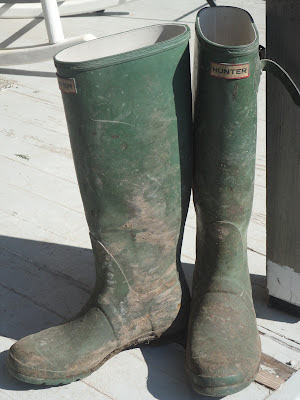 Tall: Because this stuff is deep and only gets deeper as the spring rains come on (if they ever do).
Waterproof: Because most of what you are tromping through is often largely made of water or the rain has added to the moisture level.
Lightweight: Because it gets really heavy when you have half an acre of mud on your boots.
Sometimes it helps if the boots have steel toes because animals can be really heavy, and it is also nice if they are big enough that you can fit a large pair of warm socks in them when the weather is cold, but both of these cut down on being lightweight, so it is a bit of a trade off.
Personally, I am very attached to my boots. They are worn year round and start to mold directly to my feet after a while. My tan lines in the summer will often extend from the bottom of my shorts to my knees where the tops of my boots are. When I dislocated my ankle a few years ago I had on a pair of boots - I really would rather have had them simply pull the boot off my horribly dislocated foot, then cut it off, but they weren't brave enough to try. I am not sure what was more painful - the foot, or watching them cut one of my favorite boots off.
Some people come home from work and put on their slippers....I come home from work and put on my boots.
So, to pass the time and quietly prepare the garden, I haul fertilizer....also known as "manure" by most, unless you are covered in it and up to your knees in it....then it simply becomes "shit".
There are very few things that you really need in life on the farm, but a good pair of shit-kickin' boots are definitely one of them. I don't usually swear, but if you can't say "shit" when you are actually up to your knees in shit, then where else can it legitimately be used?
The ideal shit-kickin' boots have to be:
 Tall: Because this stuff is deep and only gets deeper as the spring rains come on (if they ever do).
Waterproof: Because most of what you are tromping through is often largely made of water or the rain has added to the moisture level.
Lightweight: Because it gets really heavy when you have half an acre of mud on your boots.
Sometimes it helps if the boots have steel toes because animals can be really heavy, and it is also nice if they are big enough that you can fit a large pair of warm socks in them when the weather is cold, but both of these cut down on being lightweight, so it is a bit of a trade off.
Personally, I am very attached to my boots. They are worn year round and start to mold directly to my feet after a while. My tan lines in the summer will often extend from the bottom of my shorts to my knees where the tops of my boots are. When I dislocated my ankle a few years ago I had on a pair of boots - I really would rather have had them simply pull the boot off my horribly dislocated foot, then cut it off, but they weren't brave enough to try. I am not sure what was more painful - the foot, or watching them cut one of my favorite boots off.
Some people come home from work and put on their slippers....I come home from work and put on my boots.
Sunday, February 12, 2012
In The Company Of Solitude
“Language... has created the word "loneliness" to express the pain of being alone. And it has created the word "solitude" to express the glory of being alone.”
~Paul Tillich
 I grew up as a farm girl. Not so much in the sense that we raised a lot of animals and it really wasn't a "working" farm by any stretch of the imagination, but it was definitely in the country without the sound of a busy street nearby or street lights to light up the night. I remember several times growing up when I would have friends over for the night and they would find themselves freaked out by the lack of noise in the middle of a dark Minnesota night.
Then I moved to the city to go to school and lived their for five years before being able to escape once again to a very tiny country farmhouse in the absolute middle of no where. Unfortunately, I was entirely too busy finishing school to really enjoy that stay. After school was finished, it was back to living in town as we started to raise our kids and pay off school loans. A total of nine years of living in the thick of things - street lights, 24 hour stores a few blocks away, sirens going off, neighbors coming home late, dogs barking at all hours.....you sort of take it all in and block it all out at the same time.
Finally, the move here. Almost a mile to our nearest neighbor, no streetlights, no cars going by, no sirens, only quiet. At night, only stars for as far as the imagination cares to fly out into the universe. I very distinctly remember a moment a few days after moving out here when I stood on the front stoop holding our baby daughter in my arms and watching my two older children, then ages 5 and 3 run down the hill at breakneck pace, their short stubby legs going as fast as they could. I looked down at the baby in my arms for only a second and suddenly my two older children had disappeared from sight. I felt my heart stop in that moment of sheer, pure panic that can only come to a mother whose children are suddenly no where to be found. All the typical thoughts of kidnapping, attacks by wild dogs, and falling in old wells raced through my brain. It, thankfully, was only a moment before I realized that the only reason I couldn't find them was because the short apple tree had called to them to climb her leafy, apple heavy branches and they were just up in the first crook of the tree, happily hidden beneath all her leaves. It was at that moment that I realized I had become "city-fied" and had become like one of my freaked out friends that felt both terribly exposed and totally alone all at the same time.
Living on a farm takes a little getting used to, but thankfully, nature is a very patient teacher.
 Instead of the street lights to light your way, nature shows you a magnificent sky on a clear winter night that takes your breath away. You realize that, if you had to you could also navigate by the stars as so many other people have had to do for thousands of years because Polaris is always where it should be. Suddenly the constellations and the stories behind them become worth knowing as they provide a sort of comfort while outside at night. The moon's large smiling face becomes a dear friend's that you enjoy seeing every 28 days and time measures out from full moon to full moon when your very blood seems to rise more with the tide of it. In the summer the fireflies light up the early evening and make the world appear as a shimmering diamond, and generally are used as a sign to the kids that it is time to head in for the night....right after they have caught (and released) a few of them.
Instead of the convenience stores and sirens you have your garden and your farm dog. At first these seem woefully inadequate to the task at hand, but then after working in the garden all day you are really too tired to notice the dog keeping the masked bandit raccoons away.
Instead of sirens and noisy neighbors, there is the chirping of industrious birds whose whole conversation lets you know the moment spring arrives because of the cacophony outside the window. The frogs chime in at night with their low "bur -up, burr-up" which roughly translates to "this mud is fine!" The crickets keep track of time and the temperature as the summer heats up. All these sounds are infinitely more agreeable than those of crowded humanity....unless, of course, one of the aforementioned crickets finds his way into your bedroom in the middle of the night.
 Instead of many houses, there is only the one - yours. This house is old, it has its secrets and protects its past well, but that doesn't mean that it isn't open to the warmth and life of a new family. There are, after all, always more secrets to protect- like the time capsule that we put together with our story and our current information and tucked it away in a wall that we built. I have always had a thing for old houses. They seem so wise somehow, they have seen so much and stood storms that have driven lesser houses into the ground, but they are alive and take some getting used to. The floor boards that creek and squeak as you walk across them and always seem so much louder in the middle of the night , the door hinges that haven't seen any grease in decades and let you know just who is coming and going whether it is an angry teenager or a seven pound cat. There is often a shifting of the entire frame of the house when the wind is strong enough, or when the pressure drops suddenly just before a big storm. The basement breathes with its rock wall lungs.....cool, moist air breathed in during the summer and warm, dry air exhaled during the winter, and in between her many rock spaces she houses any number of very small neighbors that I have come to not only respect, but admire in many ways as they are extremely efficient in keeping many other creepy crawlies away.
 The longer I have been here, the more I revel in the quiet and the solitude. I would rather spend a day communing with the bees in my garden then most people I know. I have come to count the animals and insects around me as my nearest neighbors and suddenly my world is very full indeed of beings to talk with when the need arises, and the best part is that they don't immediately consider me an idiot for expressing my views, whatever they may be.
I believe that, for many people, it is more of a comfort to live in town and have a network of humanity close at hand, but it often masks how much we really do rely on nature and the world around us to survive. There really isn't any less nature in town - there are still all the same microbes in the soil, the same insects in the air, and many of the same animals that scurry around the neighborhoods at night, but it is easier to put that out of the mind in a town or city. My daughter has often admitted to being afraid of the dark - more precisely - afraid of going outside after dark - which, for most kids is understandable. The dark, for me, has become such a part of what I know that even the shadowy shapes that I see moving along beside me now are nothing much to be feared....especially when they answer to the name of Vincent, Tink and Frank - a few of the farm's cats. And as to the occasional raccoon and possum that happen to stumble onto the same path- as I have explained to my daughter- they are as much afraid of us as we are of them.
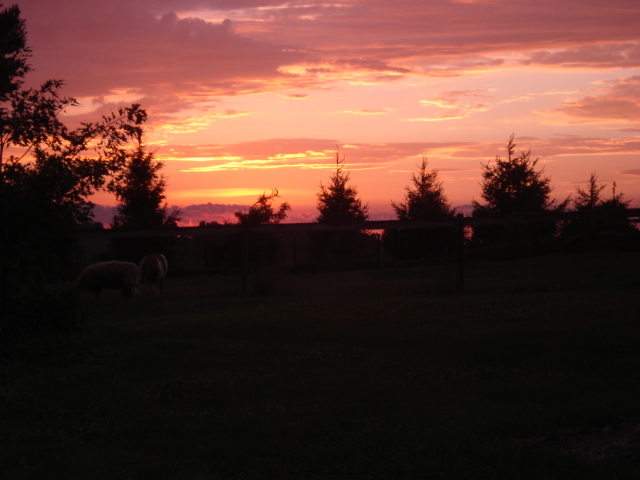
Nature speaks quietly but if we allow ourselves to hear it, to work with it, and to understand that we are also a part of it....suddenly we are no longer alone in our solitude, but surrounded by friends that are all entwined in the wonder and travail of the earth.
Sunday, February 5, 2012
Little Miss Muffet
"Little Miss Muffet, sat on her tuffet, eating her curds and whey....."
I have known this nursery rhyme since I was tiny. Being the arachnophobic kid I was, however, I never really gave a thought to what "curds and whey" really were - I was much more concerned about the eight legged beastie that came to sit beside her. I always assumed that curds and whey were some gloopy thing that kids back then ate - kind of like oatmeal.
I have since come to realize a few things....spiders are not that frightening, and curds and whey are really kind of cool. The former has taken me many, many years to learn and the latter happened a few weeks back while experimenting in the kitchen.
We have a very young milk cow on our farm, Hazel. She is too young yet to breed and milk, but in preparation for that, I have started doing a little experimentation with milk in all of its many forms.

Milk
Cream
Butter
Butter Milk
Cheese
Yogurt
Whey
Ice Cream
If you would have asked me a few weeks ago to list all the different forms of milk this list would have been much shorter. Milk was always just milk, in my mind. You pick it up in the dairy section of the grocery and then you walk around and get all the other things individually wrapped and packaged. What a weird sort of disconnect.
Both of my parents grew up on farms in South Dakota and milked cows - my dad tells many crazy tails of milking the cow and then simply straining out the dirt before drinking it, and shaking a quart jar with cream in it that would then become butter faster than a wink. I was curious just how much of this might be true and I wanted to experiment a little before I completely committed to the apparent insanity that is milking.
Finding a good source of milk that has not been ultra-pasteurized can be one of the most challenging things, but with a little work, a source was procured and a gallon jug of "milk" obtained. Let me explain something here - milk, in its pure form, will contain a certain amount of butter fat based upon what type of cow it is. This particular milk came from a Jersey which has one of the highest percentages of butter fat. What that means is that given a day of sitting in a cold fridge, the milk and the cream (aka butter fat) start to separate naturally on their own.
My first experiment was the "butter in a quart jar" story that my dad had repeated many times. I pulled all the cream off the top and put it into a quart jar. Then looked up the directions for making butter - one of the first steps is to let it age and warm. This seemed to go against every principle of "good milk technique" but given that it was only 2 cups of cream, I wasn't going to sweat it if it went bad. Actually, one of the recipes said that soured cream actually makes butter quicker than sweet cream. So.....it sat on the counter all day and got warm. After my husband had picked it up several times throughout the day and looked at it and then looked quizzically at me as if to say, "are you sure about this?" I decided to give it a try. Chilled a different quart jar for 30 minutes in the freezer and then poured in the cream and started shaking. This is one of those things that I wish I could slow the reaction down somehow and actually see what is taking place on a molecular level, but it quietly and quickly shifted from cream, to thick cream that sticks to the glass, to whipped cream that barely sloshes from side to side...and then, with 15 more shakes of the jar and as though I had said, "Hocus Pocus!" ....into butter. Bright yellow, beautiful butter.

The butter was in the jar along with a liquid - butter milk. Butter milk is what you get in the production of cream into butter and it went into a different jar to be saved and used in making pancakes the next morning. The butter was an incredible color - many of the recipes said something about adding yellow food coloring if it was too pale, but given that the cows are grass fed, there was clearly enough beta carotene in this butter to make it a lovely yellow color....no artificial anything added. I kneaded it with a fork to "wring out" all the excess buttermilk and then washed it in cold water to rinse any remaining butter milk out of it. A little salt, a little more kneading it with a fork and from 2 cups of cream I obtained half a pound of butter.
The next gallon of milk led to the cheese experiment. We had recently been down to Kalona and were perusing a few new stores when I happened upon a box of do it yourself cheese making equipment. Citric acid, salt and rennet enough for 30 batches of mozzarella cheese. At our house, the mozzarella cheese gets used by the pound, so this sounded like a great place to start.

 Here again, it felt like some amount of magic that took place - a gallon of milk mixed with a little citric acid and then heated to 90 degrees. Add a little rennet, which is essentially something that is produced in the stomachs of most baby animals that allows them to make a curd from the milk that they drink. Most of the rennet available today is produced through other means. There are other vegetable/plant sources and some genetically modified bacterias and fungi that have been "built" to make rennet. At any rate, I used the rennet that came with the cheese making supplies, a small amount of which was dissolved in cool water and then added to the warmed milk. Five minutes later, I had a pot full of cheese curd.

 This was cut into smaller curds and then stirred and warmed to 110 degrees. Another two minutes of stirring with it off the heat and it was ready to stretch. The curd that is formed is warmed to approximately 135 degrees and then stretched like taffy to lengthen the proteins in the cheese.
 Add a little salt and herbs, then shape into a brick .....Hocus Pocus....cheese! The left over whey, which is very high in proteins, gets used when we make bread or pizza crusts and works very well. Milk is very much like the pig - you can use everything but the oink of the pig - there isn't really anything wasted from milk either.
Milk has to be one of the most versatile foods. I know there is much discussion about why we, adult people, continue to drink milk from an animal. The only thing that drinks milk typically are babies, but we, as a species, have adapted it in many ways - made it more complex and tasty, made it more solid so that it can be added to recipes and melted, grown cultures in it that help with intestinal health. Milk has evolved with us and when broken down into it component parts of fats, proteins, carbohydrates, and trace minerals, milk really is quite an amazing food. When you think about the fact that an animal, by eating grasses that are completely undigestable for us, turns those grasses into a liquid that can be formed into so many different foods....very cool indeed.
My latest experiment with milk has been to make yogurt which is essentially a very soft cheese. This is perhaps the easiest thing of all. One quart of milk and three tablespoons of plain organic yogurt - mix well and let sit somewhere warm for at least 12 hours. (Mine stayed in a slightly warm oven). Strain off the whey and then flavor with whatever you want - fruit, vanilla, etc. This yogurt, unlike all the ones that you will find in the stores, doesn't have any sugar added so initially will take some getting used to or will necessitate putting some sugar or honey into the mix to sweeten it just a bit. I would love to say that I know how tasty it is, but my husband ate it all before I had a chance to taste any. If only a spider could have frightened him away.
Thursday, January 26, 2012
Going Around the Bend
"The food you eat can be either the safest and most powerful form of medicine, or the slowest form of poison."
- Dr. Ann Wigmore, ND
 It has been pointed out to us several times lately that we (meaning my husband and I) have "gone round the bend" a little with regards to food. Some come out and say it simply, "You guys are nuts!", others (like my mother) are more subtle, "Oh, it was nice to go visit your sister, we could talk about food....she even goes to Sam's Club" to which I give a small, involuntary shiver of horror and then smile and nod politely.
I don't deny that we have drastically changed how we live in the last 8 years and we actually are aware of how unusual we must come across to people. We sometimes go out at night to the local bar and eat nachos and drink cheap beer and discuss how stilted we have become about our food while playing a few games of pool, but here's the hard part....once you know the truth about food and what you eat, how do you put the blinders back on and go back?
Our progression into "craziness" went something like this:
- Watching one of your children become sicker and sicker wondering what was going on!
- Child diagnosed with a genetic disease that causes her body to react to gluten.
- Realizing that gluten is in just about everything.
- Freaking out in grocery store over what to feed your two -year-old that won't end up poisoning her.
- Learning to read labels.
- Wondering what exactly carrageenan, carnauba wax, and soy lecithin actually are.
- Finding out what they are.
- Applying Occam's razor to the food concept and realizing that, in general, the simpler foods are the better they tend to be for you.
- Finding a source of these "simple" foods.
- Realizing that it is cheaper and a ton more fun to raise/grow/process/store them ourselves.
- Raising/growing/processing said food.
- Watching as your friends, neighbors and relatives all think that we have slipped off the deep end.
The luxury, (and I do realize what a luxury it is) is that we have time. We have had a lot of time. Time to read, to research, to analyze, to try stuff out, to grow food, to process food.....it uses a lot of time. We have, by some small miracle that I haven't quite figured out yet, set ourselves up to get by on only one income from one outside job. In today's society, that is no easy feat. To some extent it is because we really don't want anything - no cable TV, no high tech gadgets, no brand new cars, no foreign holidays, no new clothes, nada. We do without and, personally, I am totally cool with that. Less overhead equals less income needed to support it. "Simplify, simplify, simplify"....Thoreau was on to something there. So our entire source of entertainment comes strictly from living and raising our kids in the best way that we can. One way to look at it is that I have learned to garden, can food, raise chickens, spin thread and knit due to sheer boredom, but the irony is that I am not bored....ever. Maybe it is a mindset that we have fallen into that we actually love what we are doing all the time, instead of constantly working at a job that we hate so that we can go out and have fun later.
In my mind it comes down to the fact that every man, woman, and child on this planet has 24 hours in each day in which to do something. For the great majority of us, what we do during those 24 hours is not likely to be earth shattering or life changing to the population at large, but what we can do for ourselves and our family can have a very large and lasting impact. Thinking back to the jobs that I have held - waitress, food service worker, lab technician, animal caretaker, veterinarian - none of those.....none.....have meant as much to me as taking care of my kids and family. I am never happier then when I am home, either working in the garden with the kids raising food, or cleaning a barn taking care of animals that I know will help to feed us. There is a very direct relationship between these activities and the lives we lead. Working at a job, for me, is an indirect relationship - still very helpful and necessary, but not nearly as fulfilling. It is a very basic desire - to provide for oneself and family.
Another reason we have jumped off the deep end with regard to food....it's political. Eating a meal, feeding your family, buying groceries - those things are political statements whether you want them to be or not. Where your fork goes, so goes your money. Buy your food locally and your money goes locally. Local money, creates local jobs. Local jobs help to maintain local infrastructure. If you understand the food market - from how the food is grown, picked, processed, inspected, shipped, stacked and purchased - then you have a pretty good handle on how messed up the system actually is. All too many of our kids (and adults) think that the food just magically appears in the grocery store without any thought to the deep and twisted roads that food must take to reach those shelves. For instance, if you don't like big capitalistic businesses, then don't buy things containing high fructose corn syrup or soy because most of the corn and soy in the country is planted, grown and chemically sprayed by Monsanto and other big Ag corporations. If you don't like illegal immigrants then don't buy produce that has been harvested by immigration workers. If you don't like government agencies then don't buy meat that has been inspected by the USDA. If you don't like pollution then don't buy groceries that have been shipped thousands of miles so that you can have a nice ripe strawberry in December. Hard to know what to buy now isn't it? All over the board there with political problems and no one party is to blame. We have simply chosen to cut out the middle man entirely and just raise our own or buy it as locally as we can from people we know.
So yes, we have 'gone round the bend' and will probably continue to do so until such time as the population at large realizes what a screwed up mess the food system is and actually takes steps to change it. My guess is that when the food system changes, so will the medical system because people will suddenly realize what they have been doing to themselves for so long. In the meantime, fair warning for any friends and relatives that come to the door for dinner, you may be asked to eat such things as organic, homegrown potato soup with onions grown in the garden outside and cheese that was produced in my kitchen. I know it is a hardship when you really crave Sam's Club frozen fish sticks, but we do what we can to please, and I promise you won't leave hungry.
"A bend in the road is not the end of the road...
unless you fail to make the turn." ~ Unknown
Subscribe to:
Posts (Atom)