Four Mapels

Four Mapels

Thursday, April 21, 2011

Dear Earth,.....Happy Day!

We do not inherit the earth from our ancestors, we borrow it from our children.  ~Native American Proverb


There are no passengers on Spaceship Earth.  We are all crew.  ~Marshall McLuhan, 1964


Never does nature say one thing and wisdom another.  ~Juvenal, Satires


Humankind has not woven the web of life.  We are but one thread within it.  Whatever we do to the web, we do to ourselves.  All things are bound together.  All things connect.  ~Chief Seattle, 1855


Tuesday, April 12, 2011

Unplugging The Kids

We move entirely too fast in society. We spend so much time with our technical devices - cell phones, computes, televisions, ipods, Wii, PlayStation....you name it and every house has at least one or two of these devices if not all of them. We are entertained at the simple flick of a switch and push of a button, but are we really any happier? Does watching movies, television shows and sporting events fulfill our lives, or is it merely a way of filling the time that we have in which we have nothing else to do? And if that is the case is there really nothing else to do?
When I think of the times in the last week of my life that I have been happy they are times that I have spent talking with people - face to face. Interactions with facial expressions, laughter, tears, hugs, and handshakes - not status updates or text messages. I think about these moments and then I consider the world into which my kids will grow up - how will they relate? and where will they find their happiness?
My daughter asked me the other day if television was around when I was a kid. Other than feeling somewhat old, I was sort of brought up short....when I was a kid we had one black and white television that we watched which quickly (during my childhood) was replaced by a color T.V. I remember fighting my brother, not for the remote, but for the "knob" that controlled the channel turner. You had to actually walk up to the television to change the channel and if we wanted to be sure that the other person couldn't change the channel, we stole the knob and hid it in the couch cushions.....juvenile, I know, but effective.
I don't remember computers being a big thing until I was in 4th grade and that was the year that my parents brought home the first "personal computer" upon which I loved to play the one game that we had which consisted of some very bad graphics of a plane that was to be shot down.
When I think of how far technology has come in the last 25 years, it is very cool and also very frightening. My kids, if left to their own devices, would love to play computer games all day, or watch movies....they would literally live in my room which is where both the computer and the television currently reside.
We do what we can to discourage this behavior.
We don't have cable. Last time I checked we get something like 5 television channels, 3 of which are PBS. We don't have a Play Station, Wii, or any other gaming system in the house and probably never will. The computers have a set time limit for the kids to be on and we do our best to limit that amount of time to an established amount based on the age of the kid. Being that the computer resides in my bedroom, all kids know that you simply do not wake Mom up on a day that she is trying to sleep in or you (and all siblings related to you) will suffer the consequences.
I have been known, when the weather is nice and I am sick of playing "screen time police" to simply switch off the breaker to my room. There is nothing quite so entertaining as seeing puzzled looks on the faces of five kids as they come out to find me and say, "Mom! The computer just stopped working! And the television doesn't work either!" To which I have to give them my most surprised look and say, "Oh, that's too bad! Maybe the electric company will turn them back on later. Why don't you go ride your bike instead?" It comes down to a simple phrase that my kids have heard entirely too many times...."Lack of options clears the mind".
There was a study done sometime recently that stated that the people that will influence you the most and shape you into the person you become are your siblings. Not your friends, not your parents, but the big brother that stole the knob to the television and then sat on it. Siblings are the testing ground upon which kids learn how to get along with others, how to share, how to fight, how to apologize, how to laugh and have fun. It wasn't clear where, exactly, that left kids that had no siblings, but in those cases friends and the siblings of friends seemed to play a bigger roll. But what about kids that now spend most of their day in front of a screen of some kind? I suspect we may find out in the next several years as those kids grow into adulthood and have to start making their way.
In the meantime, I do my best to unplug the kids. I love watching them play in the gardens, argue over who gets to play the part of the princess this time, and recently my favorite activity that the girls came up with was playing pioneers with their own covered wagon. Watching my oldest daughter, playing the part of the horse, pull the other three over the hill and then turn suddenly which led to a rather rapid capsizing of the entire wagon with three pioneers inside was, to say the least, rather entertaining. After the different body parts of the occupants of the wagon were sorted out and it was discovered that no one had been seriously injured, they went back to playing, but all three decided that they would now be the pioneer that walked next to the wagon instead of riding in it while they were on a hill. Many lessons were learned in that little adventure - how to make a cool wagon using woven wire fencing and a feed bag, how to travel in tight quarters with family, horses (even if they are your own sister) are not always reliable while pulling things, and the effects of gravity. None of which can ever be truly learned from a computer or television screen.

Sunday, April 10, 2011

Eyes Up On Good Friday

Good Friday is quickly coming. I only note this because it is a big day on the potato calendar. Where the tradition ever got started to plant them on Good Friday is beyond me....mine will be going in slightly earlier than that if the weather holds out.

Potatoes - one of the first, and most labor intensive, crops to go in during spring planting - are very much worth the work. From the mighty potato comes such wonderful things as: french fries, baked potatoes, mashed potatoes, home fries, fritters, hash browns, new potatoes with rosemary, and potatoes stew with pot roast to name just a few. A tuber worth its weight in gold....especially Yukon Gold.

I ordered the Yukon Gold seed potatoes from Seed Savers this spring since we didn't have any seed potatoes left over from last year. Last year's crop didn't fair so well - a combination of bad type of potatoes and excessive apathy on my part led to a short supply this winter. So, we start again with new seed potatoes which is probably a good idea anyway as potatoes are susceptible to blight....just ask any Irishman.

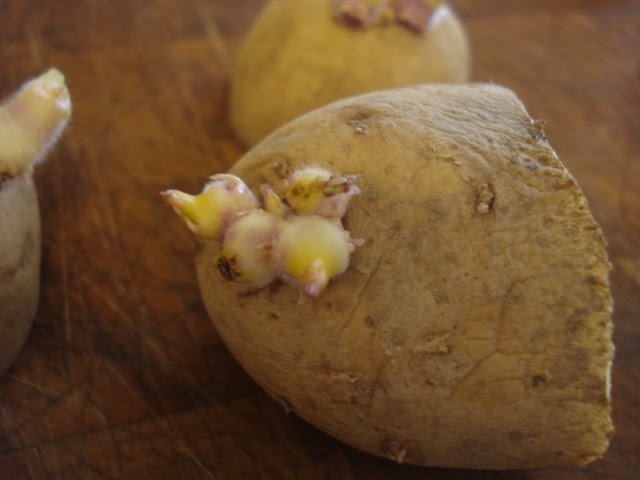
Potatoes are uniquely programed to start growing when the time is right - regardless of where they are. The conditions have to be favorable, but even in less than ideal circumstances, potatoes with yearn for the sunlight. I discovered this when I kept a crop of potatoes over winter in our root cellar and it became a little warmer than usual toward the end of winter. When I went down to get the potatoes to start planting, I found bags that looked as though they had been attacked by thin-armed octopi - there were eyes sprouting from every potato in the bags and they had grown right out the top and were headed "up" regardless of how much concrete and wood stood in their way.

They truly are one of the most "determined" crops, which makes them fun to grow. My seed potatoes came on a day when I had company over and they were anxious to see what the seeds of potatoes looked like. "Well, they look a little like potatoes" I said with a smile as I brought forth the bags of small, round beautifully kept spuds. "That's the thing about potatoes, the end product is also the starting point." The hardest part, that I have found, is keeping them in the right conditions so that they don't start to sprout too early in the spring.

The seed potatoes that I had purchased needed a little help to get started because they had yet to start producing eyes. I put the bags of seed potatoes into brown paper bags and put a small piece of apple in with them. Then.....I left them alone at room temperature in my kitchen where I would check on them every few days to see how well they were progressing. Why the apple? There is something about apples that makes a potato just want to start sprouting - whatever chemical signal it is, it works well.


As soon as a few eyes appear, I gingerly remove them from the bag...you don't want any eyes to pop off if you can help it. The sharp knife comes out and the carving begins. There are only a few requirements for cutting up seed potatoes - they need to have a little chunk of potato (I think the suggestion is 1 inch square) and they have to have at least 1 or 2 eyes that are starting to sprout. If they are small potatoes, they are best to leave whole. After they are cut, you have to let the healing begin. I typically will either place mine back in the brown paper bag, or I put them on a tray and tuck them somewhere dark for a few days to let the cut surfaces heal over.

The hardest part I have found around here is trying to find new ground upon which to plant the potatoes. They should be rotated to new soil every year and avoid any areas where they have been planted for the last three years- this makes for some interesting shuffling of crops around here, but we can typically carve out an area that hasn't housed a spud for a few years. The soil should be loose and sandy with lots of organic matter - this is where having horses around really comes in handy. A few loads of horse manure and a little tilling and we are good to go.....except for the trench digging.

Digging potato trenches can get to be a full work out. I typically use it for whatever kid is misbehaving the worst on any particular day....it is the farm equivalent of the "hard rock pile". Six inches deep, shovel width wide and don't stop until you run out of room or potato pieces.

The actual planting of the potatoes is a snap.....set them in the trench about 18 - 20 inches apart with their eyes up.
This last part is important. My first year on the farm, I couldn't remember squat with regards to gardening and I am pretty sure that I planted them all with the eyes down, thinking that they were the roots....not so....the eyes are part of the plant that will emerge above ground in a few short weeks. Thankfully, as I mentioned before, potatoes are a determined crop and I think that at least some of those originals did still make it to the surface eventually and the rest are probably still busy growing toward china.  Eyes up - they have to look where they are going.

I will then typically cover the potato pieces with approximately 4 inches of soil and wait. As they start to sprout above ground they can be further covered with another 2 inches of soil and compost to encourage more potatoes. After they are fully sprouting above ground and I have covered them with as much dirt and compost as I can stand to cart around, they get mulched with a thick layer of newspaper and straw to keep out the weeds.

As I write this now I have planted somewhere near 100 potato pieces that, if they produce as they have in the past, will lead to somewhere between 100 and 200 pounds of potatoes at the end of the summer. We will live well on potato soup, home fries, fritters, frittatas, baked potatoes, hash browns, mashed potatoes - you name the dish and a potato can probably be used to make it better. Knowing that they are planted snug in the ground only to be resurrected again in the fall will truly make this a Good Friday indeed.

Monday, April 4, 2011

Welcoming Hazel

Our little farm has added a new resident!
Hazel
We were tooling around Kalona collecting our yearly pig supply from an Amish farmer we know, "One-armed Marvin" - as though being an Amish farmer isn't difficult enough already, he does it all with one arm- we asked if he had any connections to someone who might have a heifer calf for sale and he recommended his neighbor whose cow had just dropped the first calf of the season on his dairy farm.
Her crazy calf antics and exuberance in taking the bottle have brightened our days and hearing her high pitched "Moo" from the corner of our barn makes us smile every time. My daughter is mastering the fine art of teaching a calf to lead - I explained that she had better start now while Hazel is still only 85 pounds because when she is several hundred pounds it will be a lot more challenging. Right now they are pretty evenly matched.
Can't say that buying a cow was ever on the radar, but now I find myself plotting and planning three years down the line when we could potentially have milk, butter and cheese all produced here on the farm.
I know the jury is forever out on the whole "raw milk" issue, but if examined logically it makes sense to drink raw milk rather than highly processed milk. Processed milk has had many of the good benefits destroyed in the pasteurization process which, assuming milk is contaminated, is a good thing. The main reason that milk was originally pasteurized was to eliminate most of the "bad bugs" that can live in milk - brucellosis, tuberculosis, listeria, e-coli, etc. But with the advent of testing, culling and vaccinating many of these diseases are becoming much less common. Not to say that it isn't a risk, but in general drinking raw milk is not quite as dangerous as most of the USDA would have a person believe.
Once again, it is because we are maintaining dairy cattle in less than ideal habitats, we force them to eat grain to maximize their milk output with complete disregard for the fact that they are herbivores that were designed to eat grass - eating processed food just isn't in their genetic vocabulary and it leads to health problems that then require even more medications to correct. A healthy cow out on clean pasture eating grass - it is a good bet that the milk she produces will be excellent. Having two parents and four grandparents that all grew up drinking raw milk is also a good indication that it can be done without the threat of instant death from listeriosis.
Eating processed food isn't in our genetic vocabulary either for that matter. We - like most species of animals - were designed to eat things.... and by things, I mean just about anything that our ancestors were able to scrape up. Humans are omnivores - plants and animals. This puts us in the same category as dogs, possums, raccoons, and pigs to name just a few. Yes, that's right....we are made of essentially the same parts and components as those dirty animals, but somehow we have come to the conclusion that if it isn't "sterile" we humans shouldn't be eating it.
The gastrointestinal system was designed to tackle bacteria of all sorts. Our stomach contains acids that are in the pH realm of 1 - that is highly acidic and this allows us to kill off most of the pathogens. Those that aren't killed off there go through to the intestine where the pancreatic enzymes change the pH to a more basic level of 8. All throughout the intestinal system there are ways that the body has worked out the most efficient system of getting nutrients from a food while simultaneously restricting the passage of bacteria and other germs - there are "tight junctions" in the small intestine to keep larger particles (like bacteria) from crossing over, there are lymph nodes that send out the warrior white blood cells when a threat is perceived, there are smooth muscles to help keep things moving through. All-in-all, a very complex system and yet we waste most of it because we insist on eating only "clean" food.
Our systems like to do what they were originally designed to do - it keeps them healthier and happier. There has been some discussion that diseases such as Crohn's disease comes about because the body's immune system has nothing better to do than to attack itself and, in some cases they have found that if they infest people with swine whipworms (an intestinal parasite of pigs) people with Crohn's have gone into remission -the immune system now has something better to work on other than itself. Our gastrointestinal and immune systems were established to handle unclean food and typically working with nature, rather than against it, is a good way to go.
There really is no 5 second rule at our house, nor do we use "anti-bacterial" stuff if we can help it. We are becoming a species that is entirely too clean and then we wonder at the increased incidence of asthma, allergies, and autoimmune diseases. All of those are signs of an over active immune system that is out looking for something to attack. Like a bored child, if the immune system doesn't have something constructive to work on, it will cause problems.
Polio is a good example of how being a little "dirty" can pay off. Polio was a disease that would often attack the clean, well kept children...why?....because they could afford to stay "clean". Increased sanitation led to a decrease in natural exposure to polio and then when the infection did occur it was more likely to lead to the paralytic form. The grubby kids in the dirt were more likely to be protected due to small doses of natural exposure.
Now that isn't to say that it doesn't pay to wash food and wash hands, but I don't think it is necessary to make everything sterile. I think about it this way: We are so germaphobic, we use anti-bacterial soap on just about everything these days, but if you read the label and see that it supposedly kills 99.9% of bacteria that leaves 0.1% bacteria behind with a clear field upon which to grow and thrive. And these aren't the weak bugs - these are the tough ones and now they are everywhere! I hate to break it to people, but there are bacteria and fungi everywhere all the time - and they are supposed to be there. They are commensal organisms and, in some ways, protect us from the other "bad" bugs by simply holding their turf and limiting the space upon which the pathogenic organisms can thrive.
I have digressed a long way from the fun and excitement of new baby calf, Hazel, but her residence here on the farm is a starting point from which we can further launch into self sustainability and getting back to a more natural way of doing things. Milk - unpasteurized, unhomoginized , unprocessed. Of course I am putting the cart slightly before the horse on this one - she has to grow up for a few years and then be successfully bred before we will see any milk, but a person can dream. And either way - a calf is a very nice way to start a cow.

Thursday, March 31, 2011

Burn, Baby, Burn

Pyromania is hereditary....at least in my family. When I was small, the thing that I remember my mom doing every spring was raking leaves and twigs and burning them in small controllable piles on the driveway. She liked the controllable piles after first hand experience as a kid with an out of control fire that nearly burned down her childhood house and lit the corn field on fire. Personally, I like the "mostly controllable" fires.
Fire is an amazing way of cleaning up a lot of last year's dead fall and left overs. What would take me a day and a half to rake and haul takes a fire about thirty minutes to eliminate. It lives and breathes on the old leaves that I would otherwise have to bag up, it rollicks along on dead grass that clings to my garden fence, it makes short work of a steep hillside that we don't mow. It takes on a life of its own and I, for one, am very grateful.
Fire was often utilized by Native Americans on the grasslands. They would light the prairie up because they knew that the buffalo were attracted to the fresh spring grass that would rapidly grow up on a burned field. Burning off the old thatch made the new growth easy to get to and would draw the buffalo into the area for easier hunting. Burning eliminated a build up of dangerous biomass - this is what leads to such catastrophic forest fires out West. So much dead fall, grasses, needles, etc build up and form a thick, but highly volatile, layer that when something does happen to catch a spark from a lightning strike - it all goes up like kindling. For so many years the forestry departments were against lighting forest fires to help control the understory, but now I think they are starting to realize that in small doses, a fire can be a very good thing.
When I say I like the "mostly controllable" fires it is because I don't usually form piles - I let the fire run, but I have had personal experience with lighting my entire farm on fire accidentally. It was mid afternoon one windy day in March and I had just taken some paper out to burn in the "burning barrel" - a very country way of disposing of most things that will burn. I didn't pay much attention to the rather tall, dry grass about eight feet away from the barrel. I walked back in the house and helped the kids get their afternoon snacks before I looked out the window and said, "Where did all the fog......" And then it hit me that it wasn't fog - it was smoke and it covered the entire farm. I raced out of the house screaming for the two oldest kids to grab pails and hoses while I ran for the rake and shovel. By the time that I got into the tree line north of our house the fire had already ripped through and attacked one of the untended brush piles that had been sitting there.
To this day, I can remember how amazingly hot that fire was and I have such profound respect for people who fight forest fires. I could not come within 20 feet of that brush pile and only managed to save one of the pine trees with a well aimed bucket of water. Between myself, and my 8 year old son and 5 year old daughter we were able to put out most of the fires within about an hour, but the final yell from my daughter to say that the barn was on fire just about floored me.
The fire had crept along the ground working against the wind and finally reached the corner of a Morton building that we have. Just on the other side of the wall was a large pile of straw and somehow the fire had slithered under the wall and started the pile to smoldering. A pile of burning straw is almost the exact opposite of the brush pile....there is no obvious source of fire and yet the entire thing belches and billows smoke. We had to completely dismantle the straw pile and then pour water over the entire thing to get the fire out. It was a long and very tiring afternoon, but the farm that spring was beautiful with all the sticks and twigs gone and the bright green grass growing out of the blackened ground.
Suffice it to say that I have learned to only light a fire after setting the stage a little. I now have water buckets filled and at the ready and a hose hooked up and ready to go before any matches hit the ground. If I am home alone, I am sure to have my cell phone at the ready to call for help - either family or professional if the need should arise. I set the "buffer" zones where the fire will run up against some green grass, dirt or line of water that I have laid down and extinguish all on its own.
And so armed, I set free the fire to clear the way for new grasses, and it burns off the leftovers in my garden. All the leaves that reside over the winter in my perennial flower beds are raked and hauled down to the garden to be burned and then tilled in for mulch and compost. It is a wonderful way to consolidate biomass and still use it for creating a sustainable soil. Burning off my garden in the early spring leads to a blackened earth that then heats up faster and will help seeds to germinate a little earlier. And at the end of a tiring, stressful day, there really is no release like giving life to a little fire and watching it eat the ground up in its fervour....no wonder my mother loves it so.

Monday, March 28, 2011

Pictures and Ponders of Spring

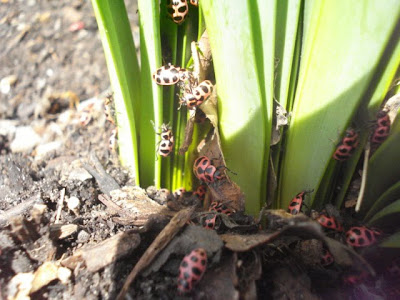
They crawl out of warm mulch, just after snow, In hidings from tunnels row after row; They rest among dew drops and fly out to bring Their red spots of colors to gardens of spring.
~Marlene Glaus
If you've never been thirlled to the very edges of your soul by a flower in spring bloom, maybe your soul has never been in bloom.
~Terri Guillemets
If I had my life to live over, I would start barefoot earlier in the spring and stay that way later in the fall.
~Nadine Stair
Why try to explain miracles to your kids when you can just have them plant a garden.
~Robert Brault
It's spring fever. This is what the name of it is. And when you've got it, you want - oh, you don't quite know what it is you do want,but it just fairly makes your heart ache, you want it so!
~Mark Twain
Everything is blooming most recklessly; if it were voices instead of colors, there would be an unbelievable shrieking into the heart of the night.
~Rainer Maria Rilke

Monday, March 21, 2011

House Bill 589

I know I should stay out of politics, but I am a lot like a moth to a flame - I know I will be torched, but I am just drawn to it, especially when it has to do with farm legislation. Recently a bill has been passed in the house of representatives in Iowa that will make it a felony to videotape any farms without the farmer's permission. House Bill 589. This I find very disturbing. I know it is their farm and they should have privacy to farm as they see fit, but at the same time they are raising food that people will be eating and we, too, should have some right to know how those animals are raised and handled. Farming has gone from being about small family farms to an industrial machine and I find it frightening that the consumers have no knowledge of what goes on behind those closed CAFO doors. The argument, of course, is that if you "see" something you are to report it to the proper authorities. Good luck with that. First of all, you can't "see" what goes on inside those confinement units - you can't see if the air is so polluted that the animals can hardly breathe, you can't tell if the animals are too crowded and therefore over stressed, you can't see if they are periodically beaten about by handlers. There is no transparency to a CAFO building. Second of all, who are the "proper" authorities? As a veterinarian I have come across instances of needing to report abuse and it can get a little dicey trying to figure out who to contact that will actually see that something is done - unless you get media on board and then enough people get angry and the "authorities" are then forced into having to actually do something about a case. There is just not a lot of accountability for some of these farmers. Dairy farmers are probably monitored the best. Their bulk tank where all the milk goes gets checked each time the trucks come from the dairy to collect the milk and if there are any illegal antibiotics in the milk, or the cell counts are too high, there are repercussions. We have no similar system in hog, chicken or turkey confinements, or in the production of beef steers. Maybe there should be a law requiring a camera placed in every confinement unit that are uploaded to a web site.....if we monitored our food like we monitor the eagles in Decorah, the entire food system might be vastly different. The biggest thing that worries me is, what are they trying to hide? Clearly, to go through all the work and effort to make a bill that will make it a felony to photograph or videotape animals that may be abused or neglected.....what are they afraid of? That they will be caught? I just don't think it is worth the time and money to pass this legislation. I think that if farmers are worried that they will be videotaped and exposed for animal neglect and cruelty, then maybe they should rethink how they are doing business. And for the consumers, I think that they should take legislation like this to heart and know that the farmers in these states apparently have something that they want to hide.....I, personally, would not want food from those farmers. It comes back around again to "know your farmer". Anyone wondering what kind of food I grow or how my animals are treated....they are welcome to come out and visit any time and I will be happy to give a tour and let you take pictures - that is what I would want from a farmer if I was buying food from them, and yet most of the country goes out to eat or cooks food at home without the foggiest notion of where their food came from or how it was treated. Needless to say, I have called my state senator and let him know my thoughts on the issue in the hopes that this bill can be killed in the senate. I would encourage everyone else in Iowa to do the same if you care at all about the food you eat. It just doesn't seem to be a bill that is worth while - it decreases the transparency of the food system rather than increasing it and while I can see the farmer's point behind wanting some privacy, I cannot account for their wanting to hide whatever monstrosities they may be committing and if they truly fear being photographed or videotaped, they need to reconsider what they are doing. The fear of media attention is the only check and balance that we have for many of these farms at this point.

Thursday, March 17, 2011

Spring Fever

I become a bit stir crazy when the weather warms up even a little. When spring starts to roll around some people clean their houses....I clean the forest. Early spring is the prime time to trim, prune, cut, sculpt, whittle or any other thing that you can image doing with branches. It is also the project that I can do that allows me to be outside working, but doesn't entice me into digging in the dirt and planting seeds or plants that I know will not be able to withstand the frosts yet to come.
I start with the "twig" pile. This is a pile, or rather two piles, that I have maintained for almost four years now. When we moved onto the farm almost eight years ago, there were three rows of evergreens on the north side of the house. They had been planted as a wind break and were very useful as such, but unfortunately they had been attacked (and are still being attacked) by anthracnose - a fungal infection that attacks trees that are in close, crowded conditions. The trees were so congested that very little air could flow through them at all. All the dead limbs were cut down and most of them were bonfire foder. The ones that were not immediately torched were placed in very loose piles on the very eastern edge of the tree strip to avoid having the predominant western wind blow the fungal spores into the remaining trees. A few years ago I finally got around to sorting out some of these twigs.
My husband thinks I am crazy, but what he fails to realize is two things: 1) working in the woods and communing with the trees makes me very happy. The happier I am, the less likely I am to let my frustration at not being able to get in the garden yet drive me over the edge.... 2) and possibly more importantly, all the "twigs" that I bag up for the winter are the kindling that helps to make his split wood actually burn. His great big pile of beautifully split wood would take forever to get to burn without the help of hot little pine sticks.
Pine trees get a bad rap when it comes to being a good wood for fuel - they don't burn as cleanly, too much creosote produced so it clogs the chimney, and they really only have the central trunk that can be split into firewood so you don't get nearly as much from a pine tree as you would from a deciduous tree. All the branches are typically too small to be of much use as firewood....but they are stellar kindling branches. The sap in those small branches dries to become like solid kerosene and they can heat up a wood burner in short order on cold winter mornings.
So, armed with a loppers, a hand saw, a leaf rake, a garden rake, and a shovel I set out to clean up the woods. The piles that I maintain are essentially branches that I have taken down the year or two before and allowed to dry fully - I simply move them from one place to another and pare them down a bit in the process. I stack them up to form rudimentary "fences" in one corner of the tree strip and this will serve to catch any wayward soccer balls or pails that blow across the yard during one of many summer storms. By stacking the wood up, it also helps to dry it out so that it is that much better at starting a fire in the winter. As I move each piece of wood I test it to see how dry and breakable it is. Most branches, after drying out for 2 years, can be broken relatively easily with a well placed boot on the midshaft of the branch. If they still have "spring" in them, they are placed back on the twig wall for another year.
After I move one pile, I dig up any of the rouge scrub trees that insist on spreading like wildfire using the shovel and all the leaves and dry grass get raked down into the ditch for eventual burning. The sticks that I have managed to break apart get loaded into the left over feed bags from the year and then they are stacked in the hog house for the summer to stay nice and dry.
Crazy, I know, but once again, it is a job that I can do outside on those beautiful spring days when you can almost believe that winter is completely finished, but you know in your heart that there will be at least one or two more snows before it completely gives up and heads south as the world rounds the sun again.
After I finish with the old wood, I start tackling the new dead branches. There are always more than I care to think about - branches that I have watched and tried to keep healthy, but they have finally given in to the canker that grows rampant in a tight knit bunch of trees. So, I wander around with the loppers on one shoulder and the saw on the other and I cut off what can be reached and then typically, I will find a ladder and go a little higher each year on a tree to cut off more and more of the dead branches. The amazing thing to me is how many new growth branches will emerge when you allow the tree to have a little light and air. The trees by our house were simply planted too close together and therefore spread their disease too easily. By cutting away the dead stuff I have allowed more airflow and sunlight into the forest and helped to reduce the spread of disease.....It works the same for trees as it does for people and animals.
The "newbie" branches are stripped of all the small stuff and then added to the twig fence to dry for a year or so. Hence, my supply continues and I don't see it ending any time too soon. We are always looking for a place to plant another tree and I have found that many small saplings take root in the forest below the mature trees - all I have to do is move them carefully to the place that I want them and then protect them from the lawn mowers.
One of my grandmother's favorite sayings was "Waste not, want not" and I have found this to be very sage advice because in the depth of winter, when the house is all of about 54 degrees and you really need to get a fire going quickly, nothing beats hot little kerosene sticks. So, I spend these first wonderfully warm days of spring outside playing with sticks and humming along in my head the childhood rhyme of "1, 2, buckel my shoe...3,4 shut the door....5, 6 pick up sticks....7, 8, lay them straight"....and I am happy in my thought that the fires of winter are, finally, a long way off.

Wednesday, March 9, 2011

And So It Begins....

It's March....at last. We have finally reached that magic "6-8 weeks before the last frost" range. Time to start the spring planting.
Most traditional farmers won't be in their field yet until sometime in April or May. I never claimed to be traditional....I bring the dirt inside.
It is almost frightening how simple it is to grow things. A little seed, soil, water, sunshine and love and you have yourself meals for a year. So, on a sunny Sunday I pulled out of the cupboard all the seeds that I had saved for the year and sorted through them. There are the piles of seeds that need to be directly seeded in the ground when it warms up a bit, there are the seeds that are reserved for kids to plant, and then there are the wonderful can be started indoors 6-8 weeks before the last frost plants.
I tracked down the trays that I use from year to year. These are approximately $10 at any hardware or garden store and, if you use them carefully, can be used year after year. I dumped out any and all remaining soil that was still clinging to the sides of the trays, rinsed them in dilute bleach solution to be sure there clean and virus free. We have found that cardboard egg cartons also work well and can be torn apart and planted directly in the dirt when the seeds are ready to transplant.
The trays are filled and the soil moistened with a little water to make planting easier. A bag of dirt can go a long way. I go for organic stuff if I can just as a standard of practice - less chemicals typically equals healthier foods. I tried my own compost once and that works as well- as long as you can recognize the seeds that will be emerging - typically compost will still harbor weed seeds that can take over, so I tend to stick with the bag of purchased dirt....one bag can start my entire garden and then some.
I survive the winter on the anticipation of playing in the dirt. It doesn't matter that it is still cold outside or that the dirt is in a bag - it is still dirt. I have found this small spring celebration to be quite an attraction and will have at least one kid that wanders by and says, "Oh! Can I help!" to which I somewhat reluctantly say, "Of course!" and hand over my seeds and my tweezers to them while I continue filling trays and labeling what they have planted.
A little warm water shower from the sink, a cover to keep them warm and moist, a sunny spot in the sun and voila! - three days later....the makings of coleslaw start poking up with onions, leeks, tomatoes, peppers, and broccoli to follow soon after.
My kids sometimes ask me about my perception of "God" and quite honestly, this is what I show them - the miracle of a seed - be it animal or vegetable. A small packet of genetic information that holds within it the blueprint to build another such being with similar, but not identical, characteristics. What I find so completely amazing is the complexity of the different species and how all of that is contained in something as small as (or in the case of animals - smaller than ) the head of a pin. That level of complexity and planning amazes me and the fact that I choose which seeds to plant and maintain gives me pause because now I, too, have a hand in what genetic information is propagated in the world. I take this responsibility very seriously. I see these tiny little seedlings not only as plants that I will one day eat, but they are the source of more seeds that I will rely on next year to plant again. They have lives and progeny and generations just like people do. They are very important beings in the world. Just because they don't have legs to move about and they eat soil doesn't mean that they are necessarily any less important than the rest of us. These thoughts often lead to me donating any extra seedlings to people to plant at their houses because I simply can't stand the thought of wasting even one.
So, it has begun. My family has grown to include these little seedlings that I will look after, care for, glean food from, and use to propagate next year's seeds. The Chinese know it best, "One who plants a garden, plants happiness. If you would be happy all your life, plant a garden."

Saturday, February 26, 2011

First Signs of Spring

Every year it is the same. I am completely astounded by the coming of spring. I recognize and expect the changing of the seasons from spring to summer, summer to fall and fall to winter, but by far the most resplendent of the changes is from winter to spring. It doesn't take much to amaze me at this time of the year. Having just spent the last four months cooped up in a house with five children is enough to send anyone screaming for the door at the first sign of nicer weather, and for me, 20 degrees can sometimes be considered nicer weather. So, perhaps it is the deprivation of winter that makes spring so magical, or maybe it is just that, as I get older, my memory is getting worse and I can never remember from year to year just how things are supposed to happen.
It is still cold out. Cold enough that a quick walk around my gardens is really all I feel like doing yet, but even during that brief walk I notice subtle changes that herald the start of spring. Last week as I was peering out my window with a cup of coffee in hand, I suddenly realized that there were buds on the trees despite the general gloominess of the last week's weather.
"What! Really, they are budding out already? Did this happen last year this early? The trees are crazy!" Picturing them like a mentally unstable relative that has declared that they will no longer wear a coat and thereby bring on nicer weather, I went out to inspect them and make sure they weren't really freezing.....not that I could do much for them if they were, but I thought I had at least have a walk among them to be sure that they were all truly budding and that it wasn't just a deranged few. Sure enough, buds all around. "Well, okay....if you guys say it is coming...."
So, then I start looking elsewhere for spring. The birds are usually the next clue and clearly it is time to start spreading my lint piles and wool leftovers for nests. April chicks are usually the result of mating and nest building that starts approximately now. The first Robin is no doubt around here somewhere, but I haven't heard them start to call in the mornings quite yet, but the Cardinals are getting into it - my son noted that the other day, that the birds are back. Not so much back really, as just vocal and trying to let the girls know.
The snow continues to fall, but there isn't a lot of confidence in it anymore. The flakes know they will be short lived and the daffodil bulbs and irises will soon be pushing up through last year's leaves. How they know it is time to poke their tender heads out is completely beyond me, but I find myself crouching over their area in the garden with baited breath waiting for their emergence and knowing that when they do show up, winter's back will be broken at last.
Spring is always a lesson in faith. The trees bud out, the daffodils sprout up, the animals start to shed their fur - all on faith alone that the earth will continue its incessant march around the sun and the days will slowly but progressively get longer and warmer whether we realize it or not, even though the thermometer still dips into the teens and twenties during the day. Faith in the future- nature has more of it than I do myself, I am afraid to say. I am, however, happy to feel its optimistic effect and let it soak into my pessimistic soul like the sun slowly soaks into the soil and turns the frozen ground into fertile loam.

Wednesday, February 16, 2011

Our Chickens Have Only One Bad Day

There comes a time in every chicken's life.....today was such a day for four of the young males on our farm. We have known and loved these chickens since the very day they emerged from their shells. They have lived a life of chicken luxury with organic food to eat, a large fenced in yard in which to roam, other chicken friends to communicate with, but on our farm one rooster is, at times, more than enough. Our day of reckoning varies depending upon exactly when chicks hatch out, so we sometimes find ourselves having to deal with chickens in less than ideal weather, but we have developed enough of a system that regardless of whether it is July or the middle of December, we can make it happen. We usually know that it is time to organize the chicken posse when the hens start looking a little harried. Too many roosters to deal with can lead to some fairly stressed hens. This usually coincides with the roosters just starting to learn to crow, so as the adolescent vocal cords are just warming up and gaining some volume our knives are quietly being sharpened. This is one of our least favorite tasks that has to be done on this little farm, but it comes with the territory of raising our own food, and we view it as a responsibility that we have to these birds to see that they are handled well and don't suffer any longer than absolutely necessary. I have explained it to my kids like this......we eat chicken - we can get it from the store, or we can raise it ourselves. A chicken from the store lived out its entire life in a small cage, never saw the sun, never chased a beetle through the grass, never crowed out its defiance and domination of the hens, never scratched away merrily at the earth worms in the dirt. Our chickens do all those things and more. If we believe in eating happy, healthy animals that we raise ourselves, then we should be able to butcher said animal. The chickens that we get from a store are scooped up, plopped in cages and driven for many miles to a processing plant with much terror and stress in the process.....our chickens get picked up and within 3 minutes it is all over. Our chickens only have one really bad day, and actually more like only 3 really bad minutes. Now, if you have a squeamish stomach, don't continue on with this post because what follows is a graphic depiction of butchering a chicken. Why? Because when we first purchased chickens and hatched out this crazy scheme to raise and butcher our own chickens, there wasn't a good source of common sense description of what was to be done. Thankfully, I invested 7 years of my life becoming a veterinarian.....glad that my education can pay off somehow....and in those 7 years I became well versed with anatomy and the best way to separate a body from its internal parts, and butchering is really just one step below surgery. *********** Stop.....seriously! If you don't want to think about butchering chickens.....stop! If you are interested, however, in how a chicken gets processed (and even the ones in the store have to go through this ) then carry on. But don't say I didn't warn you. I apologize in advance for the poor picture quality....I was inside with one incandescent bulb and chicken liver covered hands The Day Before Reckoning Day Before a chicken meets the butchering knife it is best if they are kept off food for 24 hours to help empty out the digestive tract. We separate ours by putting them in a smaller "hut" with water and their other doomed friends. Reckoning Day A few key items to have on hand:
  1. Sharp knives....and by sharp I mean as sharp as you can get them because they will dull quickly.
  2. A cone-shaped holder. Sometimes called a "killing cone" for reasons that will be explained later.
  3. A large pot to boil water in that will also hold a chicken
  4. A bucket of dilute bleach water and a few rags for any clean ups that may have to take place
  5. A place to hang the chickens to bleed out
  6. A place to hang the chickens for plucking off feathers
  7. A blow torch or other mean of controllable flame
  8. A clean table upon which to dress out the chicken
  9. Rubber bands - one for each chicken
  10. 2 gallon freezer bags
  11. Sharpie marker
  12. Latex gloves
  13. A bucket or other garbage storing device that you can throw the entrails, feet and heads in
You're still reading.....I can only assume that your curiosity has gotten the better of you. The first time that you behead a chicken, it can be a little unnerving. They really do flop around a lot so the saying "running around like a chicken with its head cut off" has some basis in reality. We catch our bird and hold him upside down. When held like this they tend to relax and become sedate. We then insert them head first into a cone that Keith made using some somewhat rigid plastic material. These can be commercially bought and are sometimes known as "killing cones". The head protrudes from the end thus allowing either slicing the jugular vein or decapitation. We do the decapitation procedure. I prefer not to have my hands anywhere near a flying axe so we put a twine noose around the chicken's head and that is connected to the fence with the chopping block at the correct point to allow for contact with the chicken's neck. I hold the chicken and control the feet. One quick drop of the axe and they are no longer aware of anything that happens. A quick end to a lovely chicken life. I would have a picture at this point, but it takes both of my hands to hold a crazy headless chicken and there is no way that I would delay this event in the life of a chicken to take time for a picture. The cone is a useful device. It controls the wild antics of a chicken not in possession of its head. Without a cone the wings flap wildly and it creates quite a mess of blood everywhere. With the cone, the wings are contained and the chicken can be held above a bucket and most of the blood can be caught. I usually start walking with the chicken to where it will be hung up since I live in the country and a little blood here and there is quickly washed away with the next rain. The "crazy flapping" is usually over within about 30 seconds as the muscles of the body run out of oxygen and the nerves stop reflex firing. Our chicken butchering is set up into four areas/events
  1. Decapitation
  2. Draining
  3. Plucking
  4. Eviscerating
Both Keith and I tackle the first part, the second event happens of its own accord as they hang upside down. Plucking tends to be Keith's job and I (being the small handed vet person) get the task of evisceration.

After the chickens have hung upside down for a few minutes, they are ready to drop into scalding water. We tend to hang the first chicken up and by the time we have killed the remaining chickens the first one is ready for the hot water. Our large enamel canning pot works well for our chickens as they are smaller than typical broilers. They get dunked completely about 8 -12 times in the near boiling water. This helps to loosen the feathers and makes them easier to pluck. The smell of hot, wet feathers, however, is not one that you will quickly be able to forget. Plucking takes patience. I usually start with plucking but quickly run out of said patience and am happy to give it up after the first chicken is done to start the eviscerating. When the chicken is first out of the water it is possible to pull handfuls of feathers rather quickly, but soon your hands are completely covered with wet, sticky feathers. I now understand how awful being "tarred and feathered" really would be. The hard part is getting every single feather... it doesn't usually work, but you can always pull an errant feather out later. When the bird is 99% plucked and looks like a proverbial "rubber chicken" and you just can't stand to pull another feather, then it is time to pull out the blow torch. We scorch off some of the odd "hair" that some chickens have by lightly brushing the torch over their skin. Then they come to me for evisceration.

First thing is first. The feet must be removed at the level of the hock. This is fairly easily accomplished with a sharp knife and a little hyper extension of the joint. Then, the neck is removed. It is somewhat hard to cut through the neck with a knife due to the cervical vertebrae of the chicken being very small and tight, but I have found that if you can wiggle a knife through the space between the vertebrae, you can eventually tease them apart. Avoid trying to "cut" the bone as this will definitely dull the knife very quickly.

At this point, what was once a chicken in my yard looks a lot more like a chicken that I could potentially buy at a store and my stress level starts to go down a bit, but all the insides still need to come out and I am sure that for many people, this is the stressful part.

I start by putting the chicken on his chest with his butt end pointed at me. I cut a circle around the tail (including the scent gland - the prominent little point just in front of the tail) and the cloacal opening. I extend the cut a little deeper through the superficial muscle layers until I start to see the gleam of the intestine. Then, a finger is all that is typically needed to break down the thin connective tissue that holds the cloacal opening and attached intestine in place. This is where the rubber band comes in handy. I place a rubber band around the cloacal opening to prevent any "spillage" of the intestinal contents. It works rather well and keeps the process a lot cleaner.

Then, I flip the rooster over on his back and extend the incision that was made around the cloaca opening toward the head along the midline of the abdomen. You run into the end of the breast bone at some point, but usually the size of the opening can be manipulated enough to allow for the admittance of a few fingers (or a hand). You have to understand that at some point in this process you will be wearing a chicken on your hand. I, being right handed, typically use my right hand for this part. I slide it into the body cavity along the right hand side. There are quite a few thin connective tissue bands that hold body parts in place, these can be broken down with some manipulation. I usually break these down and work from right side, down onto the spine and then to the left side until I feel like the mass of entrails are generally loose. Then, reaching as far forward as I can, I grab hold of the mass (typically the heart is the most prominent organ in the front) and gently and steadily pull back toward me. You don't want to jerk because that may cause something to rip and ooze all over.....not a pretty sight! Eventually, and usually with a horrid "sucking" sound the mass will come out.

There are a few organs that undoubtedly get left behind, namely the lungs and the kidneys. The lungs reside toward the head of the chicken and on either side of the back. See the picture at left....the knife points to wear the lungs usually reside. They are typically tight to the ribs and need to be gently freed from the body wall. I usually do this by scraping a finger in between the ribs - when you feel something soft and spongy....that will be the lung. They usually peel out easily and are a wonderful pink color that my friend and I have since used to describe the color of many things....."oh, that is the perfect color of chicken lung!" .....I know, I know....sick, but true.

The kidneys are a bit more difficult. These reside in the bones of the pelvis and behind many nerves and tendinous attachments. The best way I have found to get rid of the kidneys is simply to "dig" them out. The picture at right show some of the nerves, tendons, etc that are over the top of the kidneys at the end of the knife. I reach into the cavity where I can get to them and break some of the attachments over the top. They usually come out in many pieces and are the area that I focus on when rinsing the chicken out, as this is the time to make sure that any kidney pieces get washed out.

At this point I usually do a visual inspection just to be sure that I have all the stringy things out and anything that looks like it may be part of an organ. Sometimes the top part of the trachea is still in the chest area and that can be a bit of a challenge to get out because it is so slippery. Periodically, you will feel something very tough and sharp at the end of the trachea - this is the carina or the spot where the trachea branches off into left and right lungs- grasping this can sometime make removing the trachea a little easier. All that remains now is the washing, bagging and freezing.

Usually we scrub them out well in cold water from the hydrant. This makes sure that there are no little pieces of anything left in the chicken. We also scrub off the outside as well. Then they are placed in a labeled 2 gallon bag and put immediately in the freezer. As a frame of reference, today (moving somewhat slowly due to the chilly whether) we, my husband and I, processed four chickens in approximately 1.5 hours - start to finish including clean up. We have been known to do as many as 10 in two hours when we get going. I know that it is a much slower process than it would be at a processing plant, but then again we handle the entire process ourselves and monitor to be sure that they are clean and properly handled. When you know you will be the one eating it, you take better care.

In between chickens I usually wipe down the table with dilute bleach and let it dry. I love it when it is sunny out as the sunshine provides a good dose of antimicrobial ultraviolet light as well, not to mention a nicer working environment. I usually change gloves or at least rinse off the ones that I am using in bleach water and I clean the knife.

Now I can just imagine that there are some people that have read this and are completely grossed out, for which I am sorry, (I did warn you at the start).... but the truth of the matter is, if you eat meat, this is how it is produced. Just because it is under plastic wrap on a nice Styrofoam plate doesn't mean that it started out that way. It started out on a farm and the quality of the farm can definitely affect the quality of the meat.

We know and can account for every aspect of the chicken that we eat. We use almost every part of the bird that we can. When we cook with these chickens they are stripped of every edible piece of meat and then the bones, skin and remaining "tufts" of meat are further cooked down in a crock pot to produce some of the best chicken broth know to man. I wish I could fully explain the quality of this food and the incredible taste. All I can do is to encourage you to find a local farmer and talk with them about the food that they produce and then be willing to pay them what they actually deserve for taking the time and care in producing a good quality product.

Friday, February 4, 2011

When it Snows and Blows

Every once in a while Mother Nature likes to remind us that she really does have the upper hand. A drought here, a flood there, the occasional mud slide or earth quake. Sometimes she gets really serious and throws together a hurricane or two, or sends a tsunami on shore to keep us on our toes. I just heard the other day that all of Yellowstone park is sitting on top of a "super volcano" that is due to erupt anytime between this second and about 100 years from now, but they really have no way to know Mother Nature's schedule for sure.

We humans are starting to get slightly better are forecasting weather - at least that weather that will effect us in the next 24 hours or so, but we remain woefully ignorant and argumentative about what effect we may be playing on the weather. Are we getting warmer as a planet or is it just a cycle of sun spots? Are the polar ice caps just undergoing a natural ebb and tide, or are the Polar Bears just going to have to develop flippers due to all the pollution that we have thrown into our environment.

I do know one thing however, Mother Nature dealt us a wonderful blow this last week. There have been very few true blizzards in the last several years, but the one that roared through on Tuesday was impressive - ten to twenty four inches of snow and winds of up to 45 miles per hour. Listening to the roar outside my windows that night was enough to make me want to hide underground like so many other hibernating animals this time of year. Keeping warm in a 100 year old farm house when the wind blows hard can be a bit of a challenge but with enough wood for the wood burning furnace, we were all fairly snug. Unfortunately, it was all over too quickly. Personally, I could have had it go on for a while longer. I love the feeling of being snow bound (as long as I am snow bound at home, anyway).

Food typically isn't an issue because there are always meat and eggs to be had around here, and electricity may come and go, but as long as we have books to read and a supply of candles to light, we are good to go. We spent a rather nice three days without electricity a few years ago following an ice storm and I was almost sad to see the lights come back on. That ice storm, however, prompted the purchase of a generator for future emergencies such as the blizzard that ripped through here this week. Ironically, the very purchase of a generator has been good insurance against ever needing one again.

The weather has started to take some interesting turns in the last few years. It doesn't take a lot of expertise to look at weather trends and rainfall averages to notice that there are changes afoot. They may be nothing more than the natural cycle of things, but they are changes none the less. Here is the part that gets me though....we will spend any amount of money on research and argue tooth and nail to prove our hypothesis on the issue of global warming, but all of that, in my mind, is a moot point. We are essentially arguing about whether or not it is okay to pollute the environment. The answer to that question is simple, and should be simple to everyone without all the arguing.

Let's simplify this a little, bring it down to an understandable scale. Picture your house as the entire world, your kids are inhabitants of other countries unlike your own. Now answer me this....is it okay to continuously dump your garbage (no matter how "clean" it is) in their rooms and they dump theirs in yours? Personally living in a relatively small house with 6 other people ,this very idea sounds all too familiar and I assure you, it isn't pleasant.

This is what we do to the earth, our one and only home, but we pass it off as "not our problem" because the world is so big and beautiful and seemingly endless. As we pass 7 billion people living in this house of earth, we are only starting to realize how finite it really is. So, regardless of whether or not we are causing the temperature of the earth to change because of our pollution is irrelevant. Stop the pollution problem and we automatically resolve others as well. It just makes sense to reduce the amount that we pollute whether or not is does anything to the environment.

It seems to me to make good sense to find other ways to produce energy - ways that don't involve drilling deep under water for oil or fracturing the ground for natural gas, both of which lead to some serious pollution as we have already seen. Reading articles and listening to leaders of the country talk about different incentives and acts that may be put into place if only they can flog through the fog of partisan politics makes me completely crazy. There are times that I wish we could simply declare war on energy and pollution - we seem to be able to declare war on everything else without due cause. The President can declare war without Congresses approval (at least for a time)......what's he waiting for? This is one war that would actually benefit everyone.

As a nation of war we have been know to mobilize all units to produce tanks and bullets, planes and guns at a moment's notice. It only took a few months to fully mobilize at the out break of WWII - car factories changed production almost overnight and the entire populace was fully on board to do what needed to be done. What happened to that spirit? Where is "Rosie the Recycler?" Now we are much more inclined to let the ridiculous politicians feebly attempt to pass some legislation that may or may not ever make it out of committee. I have complete confidence that if an actual "call to arms" were made to the American people to find a way to only use renewable resources for our energy within the next 5 years, we could do it. We simply choose not to. It is very depressing. Gas is still too cheap and easy to come by and the large fossil fuel companies still control too much of the government.

So what to do while the Leviathan still lives and breathes its toxic smoke into our atmosphere?

Good question. We have implemented a lot of small steps as I am sure most people have. Cloth grocery bags, recycling anything and everything that can be recycled, smaller car to increase fuel efficiency. At some point you think, "Am I really making any kind of difference, " but I have to believe that even if we don't have a zero carbon footprint, at least we are doing what we can to minimize it. I plant the seeds in my kids' heads of a day when all the energy may come from wind, solar and geothermal energy sources and their cars will run on electricity produced from these sources. I encourage them to think about the future that they would like to see even as I apologize that my own generation has been so terribly apathetic about making it a reality. Sometimes, you have to imagine something to be possible in order for it to happen.

We woke up on Wednesday morning after the wind had finally died down, to a world that had been completely transformed. Snow drifts 6 feet high, snow sculpted into unusual shapes and folds, hills transformed into flat lands and flat lands transformed into hills of snow. It is amazing to me the changes that can be wrought with a little wind and I find myself perpetually on the side of Mother Nature. I know that no matter how much we humans screw up this world, one way or another she will be there to remind us that she, after all, is still in control. Blow on Mother Nature, blow.

Followers