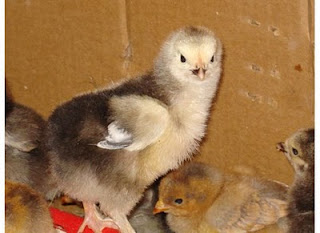
Somehow I had a feather brained idea to get chickens. This was four years ago now. Looked up
Murray McMurray website and ordered some chickens to be delivered in the spring. Didn't have a place for them to live, had no idea what to do with a chicken really at all, but how hard can it be? Right? When I get set on an idea, I am somewhat hard to dissuade.....I think 'bull headed' is generally how I am described by most of my close friends and relatives. It does get the ball rolling though, and sometimes that is really all that needs to happen to make it go.
6 am on a Saturday in April, phone rings and I can barely hear what the person on the other end is saying over the "peep! peep! peep!" in the back ground, "Your chicks are here in the post office for you to pick up." Normally, we like to sleep in, but Keith scrambled out of bed and headed into town to bring back the 24 chicks (plus 1 free rare one) that were now the newest residents of the farm. He came back about 30 minutes later carrying a rather small 1 foot x 1 foot square box with a rather noisy bunch of one day old chicks in it. I had scrambled around the house to improvise a confinement system that would hold them in until a more per
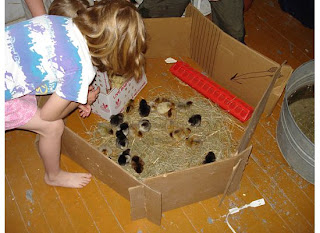 manent
 dwelling location could be devised. Had to keep them out of the house because the house cats might eat them, had to keep them warm because that was what all the books said. I had managed to pick up a small
waterer and feeder ahead of time. A quick knife to a few cardboard boxes and
voila instant chick brooder. We set them up on our "stinky porch" - so named by our children due to the fact that the garbage resides out there and it does, in fact, sometimes stink......but that is another post altogether.
There is maybe no other baby creature as cute and fluffy as a one day old baby chick. Watching them scramble around their enclosure was absolutely mesmerizing. The kids would sit out there for hours captivated by the random, chicken brained ramblings of the little ones. The "free rare chick" was quickly dubbed Brownie as he was the only one that looked a little different and could therefore be picked out of the crowd.
McMurray had actually sent us 26 chickens because there were a few in the box whose health was rather questionable right from the start. I inspected them and tried to tube feed them as any good vet would, but they just didn't have it in them. Try explaining that to five kids who are suddenly and completely in love with the sickest of the lot. There were tears all around when the two sickest chicks passed away and a small funeral ceremony held in their honor....and then life went on and the kids walked away from the episode understanding a little better the fragility of life.
One thing about chickens....they grow fast! It took no time at all before they were jumping up onto the sides of the brooder and inspecting the great beyond, just outside of their known world. Thankfully, Keith had been hard at work on a permanent chicken residence. Not only that, but the idea of the chickens now residing in one of our previously unused sheds prompted the fixing of the roof of the entire building. Suddenly, what had been a dilapidated building was now a snug little shed in which to house the chickens, and potentially any other farm animals that came our way. Turning them over to the wilds of the world, however, proved heart wrenching.....not that they weren't fine, but as Keith said one night when he finally came in from the chicken house. "
Geez, it is like sending your kids off to college - I feel like I should put up a cot out here!" You get attached to the little things. I have heard that raising chickens becomes an addiction. I know that whoever said those words knew what they were talking about.
Our plan was to have them be "free range" chickens, which is all well
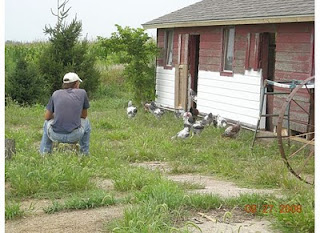
and good, but it takes a certain leap of faith to allow these young feather brains out the door and only hope that they somehow come back. There were several tentative trials of letting them out for a few minutes only to shepherd them back inside almost immediately. One of the biggest worries were the many farm cats that we keep. They are kept so that the rodent population doesn't get too out of hand. That, and the fact that, as a veterinarian, you tend to acquire many of life's "castoffs" that don't have anywhere else to be. One such cat was Sparky. He came to the farm because his claws got him into trouble and the people that had him needed to get rid of him.....hence, my house. He had grown into quite a nice cat and a very good hunter.....especially of chickens.
One morning, I had just finished the chores and was about to head off to work when suddenly I heard a "PEEP!" coming from very near the closest shed to the house. I knew that there was no way that the chickens, housed in the building furthest from the house, could be that well heard from where I stood on the porch. I looked out toward the shed and low and behold, here comes Sparky with a half grown chick in his jaws peeping away. Torn between panic and knowing that if I rushed the cat, he would likely run out of range entirely with his catch. I called to him in my most cajoling voice, "here kitty, kitty" and he stopped and raised his tail in recognition as though to say, "Hey! Look what I caught for you!" Somehow, I managed to sneak a hand in and get him around the scruff of the neck at which point he dropped the bird. The chick took off running and stopped in a shaded area the swing set, but now I noticed
another cat headed toward the unsuspecting chick. I grabbed this cat by the scruff and now had both hands full of mighty hunters. I knew I had to contain the cats because even if I just took them away and set them down, they would beat me back to the chick's hiding spot - cats are brilliant like that. So, I settled on trapping them in my husband's shop for a few minutes - although hard to turn the handle on a door when both hands are full of squirming, hungry cat. Tucked one of the cats under my elbow in a snug football hold, turned the door handle and tossed them in and shut the door as fast as possible.
The chick was still in the same place, thank God and I was able to corner it and pick it up without too much trouble. Still too
shocky from being in the jaws of a carnivore. I looked it over and found that all that had happened was that there was a puncture hole that went through the neck and into the crop where food was spilling out. I took the stressed out little tyke into the house and rinsed off the skin to fully analyze the damage. What to do? Too little to kill and eat, potentially healthy enough to be fixed, but usually the stress of medical care will sometimes alone kill them. I reached for the junk drawer. When in doubt, the answer may just lie in the junk drawer.
Super glue has so many wonderful uses, but one of the greatest is fixing cuts. It is very similar to "tissue glue" which is the surgeon's answer to what to use. With glue and chick in hand I walked up stairs. Keith was still soundly sleeping and again, with things in each hand I didn't have a good way of getting his attention without being too loud. "Keith! Keith! Get up! I have to glue a chicken!" I said as I kicked the edge of the bed. He sat up blinking and said, "What?" I quickly explained the situation as we went downstairs where the light was better and over the sink I glued the chicken's neck closed. With a few simple prayers thrown toward whatever God might watch over mauled chicks, I took him back outside to be with his buddies. Within minutes of being back out with the other chickens, I could no longer figure out which chicken it was. To this day, I don't know if it was one of the roosters that we eventually butchered, or if it is still one of the hens that lives out in the shed. It healed up without incident thanks to Super Glue.
Straight Run
When I ordered the chickens, I ordered a straight run, which means that you will get both males and females in the mix. We were excited about all the wonderful eggs that the hens would give us, but we opted not to dwell on what would happen with the males.

Eventually, on October 20
th the first little egg appeared as though by magic one morning. Small, but perfect, this little egg has become immortalized on our shelf for all time (or at least until some kid knocks it down) - I blew out the inside and shellacked it to remind us how good we have it to get free, home grown eggs.....and to remember how long we have been eating those eggs.
The boys were getting ever bigger, although it was still a little hard to tell just which one the "boys" were because they hadn't started crowing yet. Within a few weeks of the first egg hatching, however, there suddenly was some very unusual noises coming from the chicken house. It sounded like a choir of pubescent boys - voices cracking all over the place as they made multiple attempts at what might one day be called a "crow" Many would start fine, but then get choked off mid crow in what sounded like a deep throat clearing. With the crowing came the testosterone and the realization that we now had almost a dozen chickens to "do" something with.
The local butcher doesn't do fowl because of the feather mess - this is completely understandable having now seen the feathered mess for myself. As an undergraduate Animal Science major, I did take a "meats" course in which we saw how many meat animals were processed and then cooked. I highly recommend this course to anyone if you have any questions at all where your meat comes from. Better yet, try this....try going to a meat packing plant and asking for a tour. Just so you know.....it will never happen. You know why? Because they worry not that you will be grossed out by the animals being butchered, but you WILL be grossed out by the conditions and how the meat is handled. It may very well lead you to never eat meat again and then were would their company be?
I have been to the packing plants as they are in process. I went as a student doing research. We had to go and get tissue samples for what we were working on. It wasn't pretty - any of it. It was loud, and disgusting, and even I could see the gross cross contamination happening. Best yet was when an entire side of beef fell off the conveyor belt. It is supposed to be then "condemned". They hung it to the side for a while and then, when they thought we were too engrossed in our work to notice, they slid it back onto the line. The USDA inspectors that are there, I am ashamed to say, are veterinarians. It saddens me to think of how low their lives have sunk to be a USDA inspector....most, to me, appear to be former shells of a veterinarian. No longer actually caring about the animals they were sworn to protect, now a mere pawn of the government and getting paid high dollars to do it too.
Anyway, back to the boys. The time had come. Reviewed how to humanely kill a chicken and "process" it, which entails removing the feathers and internal organs all without contaminating the meat in the process. Our chosen method of humane euthanasia was La Guillotine also known as "the axe". We devised a cone that held the chicken securely and quietly and then if you hang them upside down for a few seconds they become almost hypnotized. We made it as quick and painless as possible. The statement "ran around like a chicken with its head cut off" has some basis in actual events, but "flopped" is probably more like it.
After decapitation, the body is immersed in almost boiling water to loosen the feathers and then the feather picking begins. This is a skill that is developed with practice. The first chickens we did took most of the day to get processed, now with our two years of practice behind us, I can tell you that just two of us can process ten chickens in just under 2 hours. But the feathers are the messiest part. They come off the chicken and stick like glue to you - to every part of you, hands, face, chest, hair. And they aren't just feathers, they are wet feathers,....hot, wet feathers, so the smell is one that you will always remember.
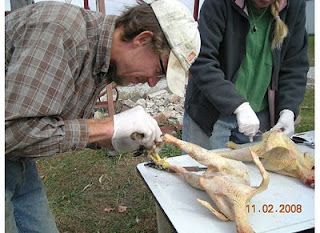
I typically get the post of evisceration, being that I am schooled in what needs to stay in and what needs to come out. The feet come off first and then the rest of the neck. A sharp knife is your best friend in this department, that and a pair of latex gloves (or several pair) After that, the scent gland and the anal opening are dissected out and tied shut to avoid any contamination. A small slit is made up the belly of the chicken and then, with small hands a benefit, you squeeze one inside and get a grip on everything from the crop and gizzard on backwards and you gently start pulling. Typically, it all comes out with a "
shlop" kind of sound and then you have to assess weather you managed to get all that you needed. Typically, the lungs have to be removed separately because they are part of the upper chest wall and attached rather firmly to the ribs. They come out easily however compared to the kidneys. The kidneys are actually within the bone of the pelvis and behind several tough nerves and connective tissue, so this requires some digging in many cases to get them completely out. The testicles of a chicken are internal and quite large - they startle many at first (including myself) in trying to figure out the anatomy. It had been a while since I had had an avian anatomy course, but after a few minutes of private review I gave a short course to the herd of kids that came around.
I have had numerous people ask me why I would let my kids see it. Why not? I think it only right that they should have some idea of where their food comes from. They understand that it was a living, breathing animal with many of the same parts as we have. They understand that we killed it in the most humane way possible after it had been allowed to have a reasonably happy chicken life of roaming around free on the farm. They understand and are grateful to the chickens for providing us with food to live on. I had seven kids running around me that day while I processed the first chickens and not a one of them was all that grossed out and were really quite fascinated by the anatomy lesson.
After the insides are out, the chicken is scrubbed (inside and out) with fresh water from the hydrant and then bagged in a 2 gallon Ziplock bag and tossed in the freezer. Does it bother us to eat these chickens that we have raised from tiny one day old chicks? In a way. But I am, as I said before happy that they lived a good life - they weren't in cages, they weren't kept shut up inside, they were protected from predators and fed organic food. I think about it, I think about them and I am grateful to them....yes, grateful to a chicken because they provide some of the very best soup and dinners of the entire year.
4-H
The chickens have brought a new aspect as well, other than just food. The kids show them.
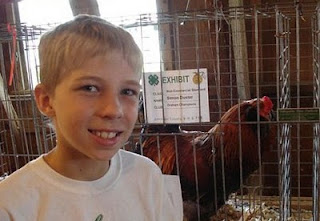
Simon's first year in 4-H was fairly uneventful because he just took projects that were judged and then sat around for the rest of the fair, but the second year....we took Brownie.
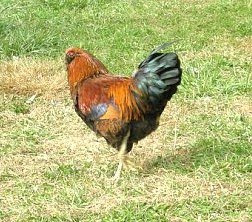
It is important with a flock of chickens to have a rooster.....ONE roster. We discovered early that two just wouldn't work because they started competing for the girls and the girls were paying the price, if you know what I mean. Bob, our other rooster had to go. We had a special butchering session a few weeks after the first and had "Bob noodle soup" that week for dinner. My daughter Ella, did have a little issue with a dinner with a name and will often times now remark, "Who are we eating this time?"
But Brownie was the chosen one. He had been our "free rare chick" that we had received and after much research, I figured out that he was an
Ameraucana chicken.
Ameraucana are one of the breeds of chickens that lay different colored eggs - greens, blues, and sometimes
lavenders. I was excited for Simon because there was so much he could talk to a chicken judge about this breed. He did his 4-H work book and learned some of the feather patterns and different types of fowl. He practiced giving Brownie a bath before the fair. We carted Brownie into town in a cat carrier for the
pre-fair blood testing that had to be done, and then the big week ca
me.
We got Brownie all set up at the fair and waited around for most of the day for the judging to happen. Five minutes with the judge and done. Kind of anticlimactic in the end, but then we were only in one class. Brownie stayed the week at the fair and you could here him crowing from anywhere you were....our purple ribbon bird.
Genetics have to come into play however at some point. And where you have one rooster and some hens, eventually, one of the hens takes it into her brain to set on eggs. I had it all planned out, according to the almanac, when would be the best time to get one of the hens to set on eggs. But hens don't read the almanac and they were having nothing doing with the bucket of eggs that I had left for them to set on. It did , however, get their little chicken brains working. Within three weeks of leaving a bunch of eggs for them to ponder over daily, two hens finally took it upon themselves to try to hatch them out.
When a hen becomes "broody" you can tell because all the do is "sit" all day. You can move them around and where every you set them, they sit and stay. They will get up once daily to walk around, eat, drink, and poop, but then it is right back to setting on eggs. These are dedicated mamas! Needless to say, the eggs that I had left for them were goners, so we slowly traded them out for new eggs daily until they each had about 10 eggs to set on. It takes 21 days to grow a chicken from an egg and it is quite possibly one of the coolest things to witness. As the time grew short to when the eggs were to hatch, we put the hens in a separate area away from the other chickens - a little "A" frame brooder house where they would be safe from all the other aunts and uncles pecking on them. I got the call at work on the day that I was a "chicken grandma" and I hope that when I truly
am a grandma, that I am half as proud as I was that day. All together we, or rather the hens, hatched out a total of ten baby chicks
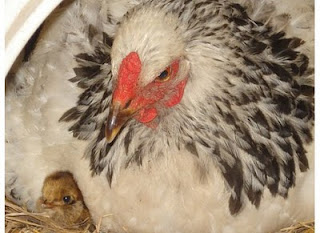
and raised them quite nicely in the little brooder. When the hens got tired of all their offspring, we moved them back into the regular flock again and then waited a while to move the babies over to the regular pen. There was a lot of chicken moving for a while. Eventually, with much monitoring and stress, the young ones integrated into the flock and took off on their own. Roughly seven months later there was another round of first eggs and butchering - one entire generation born and raised on the farm.
There is a definite learning curve involved in raising chickens, and ours has been (so far) about three years. We have had a few more hens hatch out a few more chicks with some limited success and some failure - mainly due to our intervention. We humans think we know it all when it comes to raising young - even when they aren't our own. But this fall, just as it was starting to turn cold, our best hen....Big Brown Hen as she is affectionately known, decided that she wanted to set on another round of eggs. I didn't think this was the best timing in the world, but chickens don't really care all that much about human opinions, so I decided to make her a "test case" and leave all the eggs laid in one day under her and NOT move her to a brooder. I figured it was too cold for many of the chicks to survive anyway, their chances of hatching were slim to none in my mind because it was 30 degrees at times and if she got off the nest....well, they just weren't made to survive that sort of temperature change.
We left her alone with 10 eggs to mind, paid little heed to what day it was and three weeks later, were stunned to find 6 baby chicks under her! 60% hatch rate....better than we had done so far when we had interveined, but they will never survive once they jump out of the nest because the other chickens will kill them. Survival of the fittest, we decided.
Mama hen was a force to behold. No chicken came within two feet of those babies without her beating them senseless. She chased off anything (including our small grey cat) that even so much as thought about bothering her chicks. She kept a wary eye out for any marauding animals and would call the chicks to her any time there was an exceptionally good spot of bugs or seeds that she had found. At night, when the temperatures dipped down into the twenties, you could find her and her chicks all safely nestled together -all of them protected under her wings staying warm. As they got older, I would go out there at night and find her sitting on the floor with 6 little heads poking out of her wings and feathers....she looked like a 7 headed chicken.
All of our best efforts to provide and protect and Brown hen did better than we ever could with all our fancy heaters and brooding boxes. Mother Nature knows best. Which came first?.....the mama hen.
Brownie's Reign of Terror
Brownie was our main man in the chicken house for the first two years. Purple ribbon winner at the fair and lord of the chicken house. There were offspring that bore his coloring and laid green eggs, but he had a certain way of ruling the roost that was a little frightening. He would eye you up as you came into the yard and sidle up to you, looking like the regal rooster that he was and then.......whoa! The attack was fast and furious and it consisted of him spiking you with his spurs in rabid suscession. He left many a person with wicked bruises - not only from the attack, but from the attempts to get away from him. I started always carrying a broom with me everywhere I went in the chicken yard. He would stalk you and follow you, waiting for the best time to attack.....when you were furthest from an escape.
It was at the height of his reign that we ordered another round of chicks - new blood and more interesting breeds for the kids to take to the fair. In this order was another "free rare chick" only this one started out black and after more research, determined that this was a Dominique chicken. He became the choice chicken for my daughter to take to the fair for her first year. From there, he became the
Champion Non-Standard Commercial Individual chicken. He not only came home with a purple ribbon, he came home with a trophy!

He was also much meeker than Brownie, so the decision was quickly made to usurp Brownie. It was a difficult decision, but it was made much easier right after he attacked me one last time. We butchered at total of 15 chickens this last summer and Brownie was in there somewhere. I am sure that he will make some excellent Brownie Noodle Soup

 needles. My first sock was a bit of disaster, looking more like a sock for an elephant than a sock for a person, but I got the basics down and now, I can honestly say that every one I have knit gets slightly better than the last. Can I just say, knitting socks is way too much fun, but the hardest part is that you have to do two
 of them!
My patience is usually good for about 1 and 1/2 socks and then I get side tracked on some other project like cleaning out closets for a while until the kid that I was intending the pair of socks for has grown and will no longer fit them. It is a good thing that I have five kids - one of them can always use a pair of socks.
of them!
My patience is usually good for about 1 and 1/2 socks and then I get side tracked on some other project like cleaning out closets for a while until the kid that I was intending the pair of socks for has grown and will no longer fit them. It is a good thing that I have five kids - one of them can always use a pair of socks.
 One resides in my cubbie in the entryway....a half finished sock from last year....I desperately hope it still fits someone

 Generally, it looks better when it is actually on a person and my kids are all competing for who gets to have it....it is Christmas time and I have Ella's name....hmm....I had her try it on just to be sure it fits.
 Generally, it looks better when it is actually on a person and my kids are all competing for who gets to have it....it is Christmas time and I have Ella's name....hmm....I had her try it on just to be sure it fits.
 And so, winter will continue to go by in a knit one, pearl two kind of fashion until I can sink my hands into the soil again and get back to the gardens.


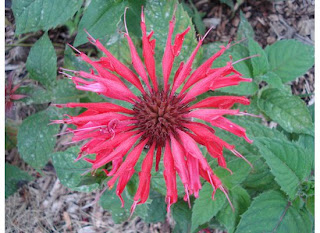
 back where it belongs (in my mind at least), or I let it run wild and form beautiful drifts of color in mid summer. As you can see from the picture, I prefer the later of the two options. Who am I to say where a flower will grow best. No flower I have ever known has read the text books....they like what they like.
Actually, one of the most obnoxious weeds, stingy nettle, makes a very nice tea. While I was out hunting mushrooms this last spring, I was completely skunked in finding any morels on many days, but I did go through many lovely nettle patches. Nettle, although very painful to work with (especially when you find yourself without a pair of gloves),it does make a great tea that is very good for people with respiratory problems. On the days that I didn't bring home mushrooms, I brought home bags full of stingy nettle instead.
Herbs are wonderful things to grow. A little sun, a little rain and they are good to go. It takes almost nothing to make herbs completely happy.
back where it belongs (in my mind at least), or I let it run wild and form beautiful drifts of color in mid summer. As you can see from the picture, I prefer the later of the two options. Who am I to say where a flower will grow best. No flower I have ever known has read the text books....they like what they like.
Actually, one of the most obnoxious weeds, stingy nettle, makes a very nice tea. While I was out hunting mushrooms this last spring, I was completely skunked in finding any morels on many days, but I did go through many lovely nettle patches. Nettle, although very painful to work with (especially when you find yourself without a pair of gloves),it does make a great tea that is very good for people with respiratory problems. On the days that I didn't bring home mushrooms, I brought home bags full of stingy nettle instead.
Herbs are wonderful things to grow. A little sun, a little rain and they are good to go. It takes almost nothing to make herbs completely happy. 





 That said, I took on this job. It started by painting the room while Keith was away. I did it as a surprise for him while he was gone working at my brother's house for a week. I did it while he was away (and called it a surprise) because he would have hovered and fretted over whether or not I cleaned the brushes out well enough after I was finished with them. This sort of "hovering and fretting" drives me absolutely nuts and is part of what prevents me from taking on other jobs. So, I did it while he was out of town.

 As with any tedious job, this one moves slowly, but I feel as though I know each board individually. Which led me to another realization. I was moving some of the trim boards around one day and I managed to get a wicked splinter in the outside edge of my foot.

